Showing posts with label history. Show all posts

Thursday, 28 February 2013

Poetic People: Caroline Gilfillan on Samuel Pepys


London and St Paul's ... but not quite as Pepys would have known it

I heard a riveting talk and poetry reading at UCS in Ipwich today. The presentation was given by Caroline Gilfillan, who has recently launched her poetry collection, Pepys, a work inspired by the famous diary.

Caroline Gilfillan’s poetry pamphlet, Yes, won the East Anglian Award for poetry in 2010. Caroline won the George Crabbe poetry competition in 2012 and the Jarrold’s Prize for the best poem by a Norfolk writer in 2007. Her poetry and fiction have been published in many magazines, including Mslexia and The London Magazine.

I visited Tate Modern for the first time recently, via the Thames Clipper from Greenwich. I took this view from the gallery, which is a converted power station. Later in the day we walked over the Thames on this bridge to St Paul's. Caroline reminded us just how different everything would have been in Pepys' day, with the devastation of the Great Fire of London ... and surgery without modern anaesthesia!

And for those who would also like to read an account of Pepys in prose, Caroline recommended Samuel Pepys: the Unequalled Self by Claire Tomalin.

Do look out for Caroline's poetry collection, published by Hawthorn Press.

STOP PRESS: I have just heard from Caroline, who adds ...

"People can buy Pepys by emailing me directly from here or via my website: www.carolinegilfillan.co.uk where they can also read some of my poems. Thanks!"

Monday, 18 April 2011

Magazine Moment (22): The Dawntreader

Mount Grace, Yorkshire, daffodil season

We always enjoy a visit to Mount Grace when we are in the area. The Priory is fascinating in itself, but I am particularly drawn to the wildlife in this beautiful setting. We have just returned from another wonderful visit. I was even tempted to pull out my pocket watercolours ...

We found a frog in a Medieval water course at the back of one of the reconstructed cells. I kept a sharp eye out for wasps' nests, as I had seen one on a previous occasion. My waspish Sonnet, 'Matriarch at Mount Grace', has just been published in The Dawntreader (p.9, issue 14, Spring 2011, ed. Dawn Bauling, IDP).
 

Wasp nest, Mount Grace, April 2011

Wednesday, 9 February 2011

Window on Wales (4): Castles in the Frame

Dryslwyn Castle: shades of summer . . .

I have just been enjoying the photo gallery of castles in Wales on the BBC Wales site here. If you have photos that you would like to submit, you will find the details on the site.

I wonder how many castles you think there are here in Wales! I knew there were a lot, but I had no idea that there were this many, with about 100 'still standing'.

It made me wonder how many of these have either featured in poems or provided inspiration for poets over the years. Speaking personally, I don't have to think very hard to name a few castles (e.g. Carreg Cennen, Tretower, Dryslwyn and Manorbier) that have influenced my own writing to one degree or another over the years.

Incidentally, you might like to see the wildlife I have seen recently as part of The Tree Year project (see side bar) in the vicinity of the castle at Dryslwyn.

Wednesday, 9 June 2010

Archeological Avenues (4): OUP - HMS Belvidera and the Temple of Minerva

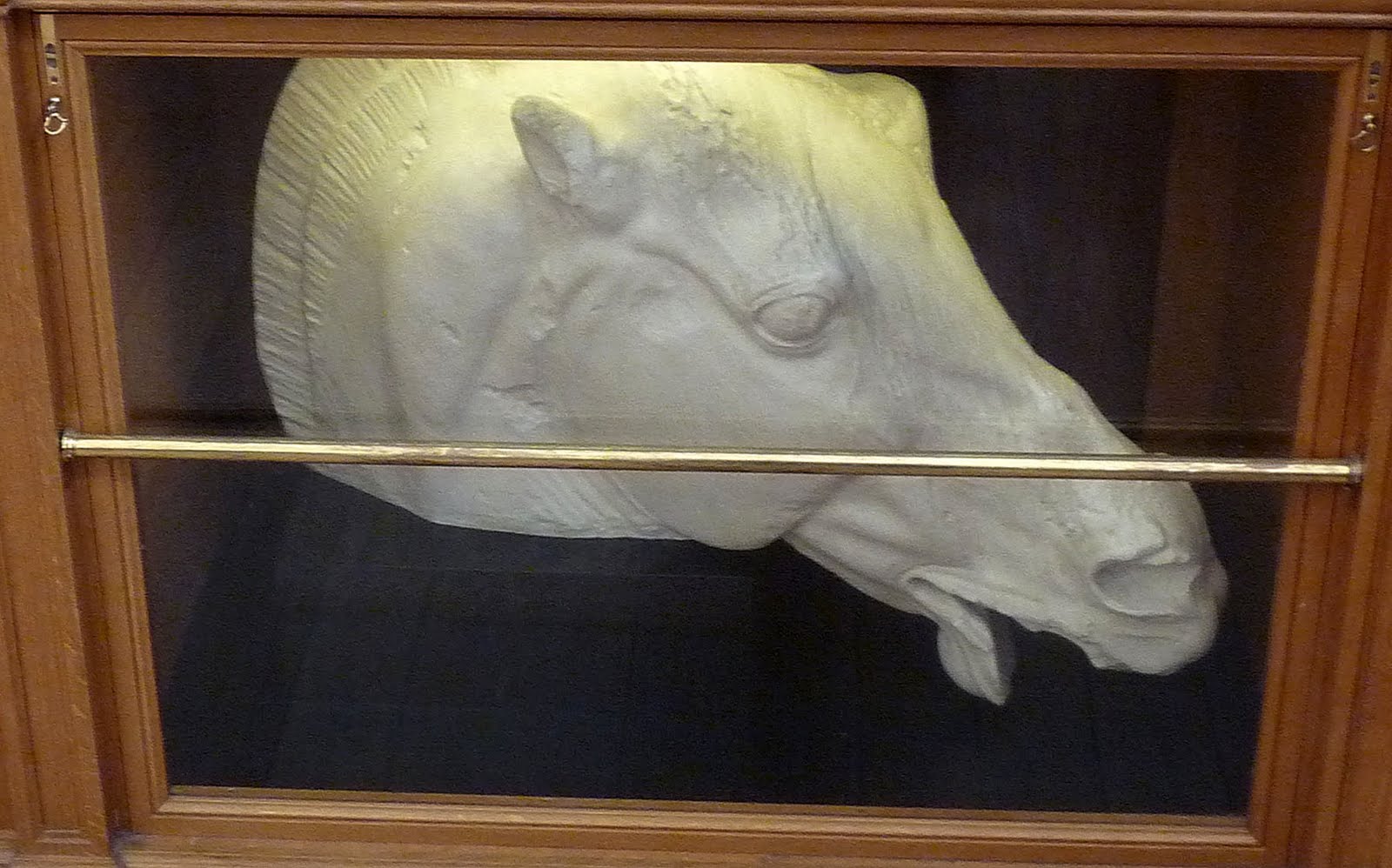
Cast of the 'Horse of Selene'
British Museum

David (Gill) and I have just received our offprints for our joint piece, HMS Belvidera and the Temple of Minerva, published by Oxford University Press in Notes and Queries. The print journal came out in June.

We consider the iconographical details on a marble book, and link these to HMS Belvidera and the Parthenon around 1832, when King Otto was crowned ruler of Greece. You may like to read my blog post here.
  • D.W.J. Gill and C. Gill, 'HMS Belvidera and the Temple of Minerva', Notes and Queries, Vol 255 of the Continuous Series [New series, Vol. 57], No.2 (June 2010): 199-210
N.B. 'Notes and Queries Advance Access' scheme: you can login via Athens if you are part of an academic community.

Wednesday, 27 January 2010

Beautiful Birds (18): RSPB Big Garden Bird Watch - and Blog Carnivals


A little reminder about the annual RSPB Big Garden Birdwatch this weekend - on 30 and 31 January 2010. Do consider taking part. You can find the details here. There may even be an organised activity in your neck of the woods.

Festival of the Trees

Festival of the Trees

On the subject of birds and their habitats, there is probably still time for you to take part in two of the forthcoming international nature-orientated Blog Carnivals, 'I and the Bird' (IATB site here, deadline 4 February) and the 'Festival of the Trees' (deadline for blog-post submissions: 30 January).

Don't miss the present IATB carnival, hosted on and around a lake created by Seabrooke Leckie ('The Marvelous in Nature' blog) in rural eastern Ontario. This is well worth a visit for the ingenious artwork in addition to the wonderful linked blogs.

You can read my FOTT post here on my Land&Lit blog for a blend of wildlife and history. If you see trees with an artist's eye, you might well enjoy a virtual wander through the new Cornish exhibition, Of Woods and Trees, at Beside the Wave Gallery in Falmouth, UK.

Don't forget: Tuesday 2 February is World Wetlands Day! It marks the date of the adoption of the Convention on Wetlands on 2 February 1971, in the city of Ramsar in Iran, on the shores of the Caspian Sea. Each year since 1997, participants have tried to find ways of raising public awareness of wetland values and benefits.

Monday, 22 June 2009

Carnival Time (1): Mug Monday (his and hers, left-handers unite!)

AcornMoon and Weaver of Grass are hosting Mug Monday today. It is a chance to write about our favourite mugs. Happy Mug Monday to you all!


Caroline's Mug

This mug belongs to me. It is bone china, which according to some, makes the tea taster better. I like to enjoy a mug of Earl Grey, made from a pinch of loose leaves. I allow these to infuse in boiling water, and then I like to drink it while it's hot. If I am out, I will often ask for a slice of lemon in my tea; but I do not usually have this luxury at home, unless of course, we have a slice left after a meal of fish and chips. (Those who know me will know that chips are 'my one weakness' ... along with cake, curry and chocolate!).

The scene on the mug relates to the Last Invasion of Britain in 1797. The women of Fishguard made a wonderful Bayeau-style tapestry to mark the 1997 Bicentenary of the Invasion, and the mug depicts a part of their work. I particularly like the spotty dog who is careering out of the picture. The cat is rather fun, too.

The Last Invasion was staged under General Lazare Hoche, who planned to invade Ireland. 15000 men were raised to ensure that British reinforcements did not reach the area. Two mainland invasions were proposed to add to the mayhem. The first was planned for the north of England and the second was planned for the west of the UK. Ships were sent out under Commodore Castagnier. Jemima Nicholas helped to rally the Fishguard women against the attackers. She became a local heroine.

These are the words of the Vicar of St Mary's, Fishguard, written on Jemima's burial record of 1832:

'This woman was called Jemima Fawr or Jemima the Great from her heroine acts ... and being of such personal powers as to be able to overcome most men in a fight. I recollect her well. She followed the trade of a shoemaker and made me, when a little boy, several pairs of shoes."


David's Mug

This mug belongs to David. Strangely we are both left-handed. It is a brilliant mug, and usually causes a wry smile in the eye of the beholder. Sadly the left-handed shop in Bath is no longer there. Perhaps I shall have to start making my own from Fimo.

It must be time to boil the kettle, but first, why not take a look at...

Tuesday, 26 May 2009

Culture Corner (1): Great North Museum (b)


The Opening of the Great North Museum,
Newcastle upon Tyne, May 2009


(a) The Great North Museum: Hancock
(b) David outside the Great North Museum: Hatton
(c) and (d) Inside the GNM
(e) 1982: Outside the - old - Hatton Gallery:
Homer's bust in the Quadrangle, University of Newcastle, Rag Day 1982!
[We took it in turns to recite bits of Homer in Greek]


There was a great buzz in the air when we touched down in Newcastle Airport last Thursday to attend an opening evening at the Great North Museum. I had first arrived in the city by train as a university 'Fresher' in 1979: what a lot has changed since then. The city has always been vibrant, but it has definitely had a 21st century facelift. Additions like the Gateshead Millennium Bridge and The Sage have breathed new life into the area.

The Great North Museum brings together a number of Newcastle collections in a stately, state of the art museum. Gone are the days when museums were dusty and quaint cabinets of curiosity. The Great North Museum - a joint initiative between the City Council and the University - is a centre for education, enjoyment - and environmental concern. You can read, for example, about the Eye Project, in which young people have been playing a key role in recording the wildlife and landscape of the North East. The data has been fed into the Great North Museum: Hancock, so that the displays could reflect the current situation. There have been two databases: one for local recordings of wildlife sightings, and another, the North East Environmental Data Hub, for the recording of wildlife and habitat information by organisations and experts in the field. Both databases will help to inform the conservation needs of local species.

We were particularly interested to see how the collection of the old Hancock Museum fitted in alongside the university collections of The Shefton Museum (of Greek Antiquities), The Museum of Antiquities (from Hadrian's Wall) and the Hatton Gallery (of Art). It is an impressive start, but it is early days. I really hope that the respective - and sometimes overlapping - needs of 'town and gown' will be served successfully under this single starry flagship.
  • Recollections by Maureen Almond (Flambard Press). Do take a look at this link. Recollections is a very special book for it celebrates Roman items from the old Museum of Antiquities, which is now part of the Great North Museum. Photographer, Glyn Goodrick's glossy photographs are the perfect complement to Maureen's poems. The poems and photographs were commissioned by Lindsay Allason-Jones, Director of Archaeological Museums for Newcastle University. The poetry collection contains a variety of forms, including examples of sonnets and haiku. Favourite poems include Erase (with an epigraph from Horace's Satires) and Aemilia and the Ring. You can click the link to Maureen's site.

Thursday, 23 April 2009

Calendar Corner (3): World Book [and Copyright] Day

Shottery, Stratford, UK

Today is not only the anniversary of Shakespeare's birth in 1564 (and death in 1616), but it is World Book Day.
Why, I wonder, do we celebrate this day in March in the UK, and not with our fellow countries in April? Perhaps it just means that we can have two celebrations for the price of one. Happy WORLD Book Day, everyone!

Monday, 23 February 2009

Creative Corner (1): Creative Spaces, a museum inititative

I have just come across a website on the Creative Spaces museum project, thanks to the British Museum Twitter feed. I have not checked it our fully yet, but it looks as though it has interesting potential.

Friday, 20 February 2009

John Buchan Stories (1): the way of the world

We are all aware that trends and fashions come and go and often come round again. When I think of the repetitions in history, I immediately think of the memorable, pithy poem on the subject (and on our response to these occurrences) by Steve Turner. It was only this morning that I came across an earlier reference to this particular aspect of the course of history - by John Buchan. My thanks to Mike Parker of Rismedia for mentioning it.

Wednesday, 4 February 2009

Surprise Subjects (1): Sugar Poetry

I try to keep an eye open for unusual poetry collections. The latest one to catch my eye is The Sugar Poetry Book: images and insights from a sugar era. The book is a poetic response by the Kittisivian and Nevisian islanders to the history and decline of the sugar industry in a part of the world that has seen so much change over the centuries.

I grew up in rural Norfolk, UK, where the view along the river Yare was dominated by the sugar beat factory at Cantley (for our sugar was beat, which can now be used as a bio-fuel). When my family moved to East Anglia in the 1970s, coypu roamed the river banks near our home. I feel a certain wistfulness when I think that these creatures are no longer there, but I know that they did immeasurable damage to the beautiful but fragile waterways and wildlife habitats of Broadland.

Postscript 4 February 2009: a penduline tit was spotted at Strumpshaw near Cantley. Source: Rare Bird Alert.

Friday, 19 December 2008

Who's dreaming of a white [stoat] Christmas?

Right: Mount Grace Priory, Yorkshire
(in the care of English Heritage)

Top: through the arch
Lower left: even the pheasants are looking for stoat holes ... or rabbits! (click on photo to enlarge)
Lower right: are there any stoat prints in the mud?

'Slowly the moon takes her brush, and drips
midnight tips on two stoat-like tails.'

Last couplet of 'Mount Grace Priory: heads and tails'
© Caroline Gill 2008
Poem published in 'Tips' (ed. Wendy Webb)
Issue 68 (September/October 2008).


Early birds listening to the 'Today Programme' on the BBC before 7am this morning will have heard the report about the resident stoat population at Mount Grace. The stoats are predicting a cold winter: they have turned white for Christmas!

Read the full story in the Darlington and Stockton Times.


Monday, 4 August 2008

Olympian Poetry?


Olympia, Greece: a Judas tree in the Palaestra, 1978
(I remember
what fun it was, all those years ago on my school trip,
crouching on the starting line in the stadium)


The Times investigates whether there would be a place for poetry in the modern Olympic Games. The Greeks included poetry and rhetoric: how could we (& should we) find a modern blend of word and action?

Friday, 25 July 2008

Burns

I missed posting a blog on the anniversary of the death of Robbie Burns (21 July 1796), but this seems an appropriate moment to make amends. I discovered an article about the making of a replica of the printing press that would have been used for the printing of Burns' poetry. You may like to visit the National Burns Collection site. The Writers' Museum in Edinburgh contains more information about the poet. The Burns National Heritage Park site has more information.

P.S. Burns is heading for a BIG anniversary!

P.P.S. Literature or doggerel? It may be my Scottish roots coming to the surface, but I would defend Burns from Jeremy Paxman's views. The Daily Mail, 15 August 2008.

Wednesday, 9 July 2008

To tie in with BBC's 'Bonekickers'?

It's almost National Archaeology Week ...

This seems a good time to post the site, Ancient World Bloggers Group.

The Lighthouse

I like to write with one eye on the lighthouse outside my window. I can't see it today as there is too much cloud, so I have posted up a Coastcard picture that I am working on.

Virginia Woolf's groundbreaking book, To the Lighthouse, hit the literary scene in a big way; but what are our favourite lighthouse poems?

One of the most well-loved ones has to be Flannan Isle by Wilfrid Wilson Gibson. There is a good BBC site on the mystery surrounding the lighthouse men. The lighthouse is situated about 15 miles to the west of the Hebridean island of Lewis.


When I was on Skye, I caught glimpses of Lewis, and the quality of the northern light (between heavy showers) was very evocative.

Treasure Island was one of my top children's adventure stories (and probably still ranks high among my favourite works of fiction). I had not realised until I visited the lighthouse on the tiny conservation island of
Eilean Bàn, halfway between Skye and the Kyle of Lochalsh, that Robert Louis Stevenson came from such a dynasty of Scottish lighthouse builders.

Left: the lighthouse on
Eilean Bàn, under the Skye Bridge.

Postscript: follow the link to
The McLellan Poetry Award. The judge for 2008 is W.N. Herbert.


Tuesday, 8 July 2008

The Muse in Museums ii

Armadale

While I was on Skye, I visited the Clan Donald Centre at Armadale, with its Study Centre and award winning Museum of the Isles. The museum incorporates poetry, including the work of six Gaelic poets by the name of MacDonald. The poems are interwoven into the 'tartan fabric' of the display, which covers a spread of several centuries. It is not so much that the poems help us to interpret the significance of individual objects, but rather that they enhance the viewer's overall experience of the museum and the story it sets out to tell.

There is an excellent virtual tour of the museum on the Armadale site. A beautifully produced glossy guide is available. It includes a number of the poems. I particularly like the poetic construction of Clan Donald's Incitement to Battle on the Day of the Battle of Harlaw, 1411 by Lachlainn Mor MacMhurich.

Monday, 7 July 2008

Of Books and Buchans: of 'gems and gold'

The 39 Steps at St Davids

Glencoe, June 2008

I was introduced to John Buchan books at school, and have loved them ever since. I was delighted to buy a copy of 'The Battle of Glencoe' (John Buchan) some weeks ago, when we had lunch in Glencoe, on our way to Skye.

Many have read 'The Three Hostages' and most people have watched 'The Thirty-Nine Steps' (in one version or another), but who has read a book by John Buchan's son, William - the 3rd Lord Tweedsmuir - who died on 29 June 2008? There was an obituary in The Times on Friday 4 July. It is my aim to get hold of a copy of 'The Rages of Time', a family memoir by William Buchan. I would also like to find a copy of his novel, 'Kumari' about India in the 1930s.


One of my treasured books is 'A Buchan Companion' by Paul Webb (Alan Sutton Publishing, 1994). It is an invaluable guide to the novels and short stories. Buchan also wrote verse: I have a copy of his 'Poems, Scots and English', published by Nelson and Sons.


Speaking of 'The Thirty-Nine Steps', we learn (or are reminded) in the obituary that the steps were 'a wooden staircase' down to the beach in Broadstairs. I live in Wales, and was fascinated to find another flight of steps with the same name. These, of course, link the small Pembrokeshire city of St Davids with its cathedral. This flight is - or was - apparently known locally as 'The Thirty-Nine Articles'. You may care to take a look at the
number 39.

Friday, 27 June 2008

Of poppies and poetry


It was interesting to see the war memorial, featuring the name of Lieutenant Colonel John Alexander McCrae (1872-1918) at Eilean Donan Castle, not far from the Skye Bridge. Canadian born McCrae wrote one of the best loved poems about the Great War, In Flanders Fields.


The setting of Eilean Donan is quite magical - even in the rain!

Monday, 2 June 2008

Bluestone

I photographed this 'Millennium Bluestone' from the Preseli mountains at the National Botanic Garden of Wales in 2001.

I have recently enjoyed reading the article 'Beyond Stonehenge: Carn Meini and the Preseli Bluestones' (Timothy Darvill and Geoff Wainwright) in the Spring 2008 edition of 'Heritage in Wales', published by CADW.