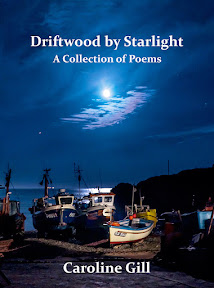
Driftwood by Starlight, my first full poetry collection, was launched online on Tuesday 3 August. The book was published in June 2021 by Peter Thabit Jones of The Seventh Quarry Press. It can be purchased from the publisher's online shop here.
Maria Lloyd, who holds a Masters degree on The City of Rome from the University of Reading, read the collection and decided to set me some questions about it. I shall attempt to provide some answers (without giving too much away ...) over the course of the next few posts.
Thank you, Maria.
This first post concerns my poem 'Monte Testaccio, Mound of Potsherds' on p.35. As I mentioned at the launch, this particular poem is intended to be something of a flight of fancy.
Let's hear from Maria on the subject of Monte Testaccio ...
- I love your use of words associated with cats; 'prowl' 'flick' 'flit', the idea that cats prefer the rich.
- Your use of ancient figures and terms is interesting: Antony, Cleopatra, bread and circuses.
- [Q1] Can you explain paragraph 3 'fur shivering through you'?
- [Q2] Can you explain: 'Testaccio reeks of centuries which nothing went to waste'?
Thank you, Maria, and before I attempt to answer the questions you pose, I would like to offer a little background information.
David (Gill), my archaeologist husband, was a Rome Scholar at the British School at Rome in the mid-1980s. We had recently married and were to spend that year living in the School, where I washed bones and sherds of pottery in my spare time. By then I had taught Classical Civilisation A Level in two different school settings in the UK and had gained a qualification in the teaching of English as a Foreign Language (RSA TEFL). I believe this qualification is now known as a Certificate in English Language Teaching to Adults or CELTA.
I was fascinated by the Ostiense area around the Piramide Metro station in Rome. My eyes were immediately drawn to the imposing pyramid tomb of Caius Cestius. You can read more about the tomb here.
 |
| Pyramid tomb of Gaius Cestius, Rome. Photo credit: © David Gill |
The 'Non-Catholic Cemetery for Foreigners in Testaccio, Rome' was nearby. It contains a memorial stone to Keats, who died from TB at the young age of 25.
 |
| Memorial to Keats, Rome. Photo credit: © David Gill |
It has been documented that the poet wanted the words you see above as his epitaph: 'Here lies one whose name was writ in water'.
 |
| Memorial stones to Keats (left) and his friend, Severn (right). Photo credit: © David Gill |
 |
| John Keats memorial plaque, Rome. Photo credit: © David Gill |
 |
| Acrostic verse on the Keats memorial plaque, Rome. Photo credit: © David Gill |
There is also a memorial tablet to Shelley, who drowned in a shipwreck off the Italian coast at the age of 29. The tablet bears the famous 'sea-change' line from The Tempest.
 |
| Memorial stone to Shelley, Rome. Photo credit: © David Gill |
It is a well-known fact that Shelley's heart failed to burn when his body was washed ashore and 'cremated'; Mary Shelley kept his heart, which was found among her possessions after her death. Edward John Trelawny, who also gets a mention in my poem, was an author friend of Shelley's. Trelawny was able to identify the body of his friend on the beach.
 |
| Tombstone of Edward J. Telawny, Rome. Photo credit: © David Gill |
There were often a lot of colourful cats in the area around Piramide Metro Station. It was some time before we realised that there was special provision for stray cats nearby. My reference to 'bread and circuses' was perhaps in part due to the free hand-outs the cats were receiving. It was, of course, also a nod to the satirist and poet Juvenal, who evoked Roman life so vividly (Juvenal, Satires, X. 70-81. Penguin translation here).
As a cat-lover, I have often observed how felines have a way of whiskering their way into unexpected places. A couple of the Testaccio ones sneaked into my poem.
Let's turn to [Q1] which concerns the lines in my poem that run as follows;
Can you feel the fur
that shivers through you silently ...
along those Tiber tales?
Those who live alongside cats will doubtless have noticed not only the occasional twitching, but also the rippling of fur, perhaps while the feline appears to be dreaming. When this rippling occurred in one of our cats, I sometimes wondered what was actually going on in her head.
Science (see here for example) may offer its own answers to the question of animals and their ability to dream, but those who care for feral cats in Tel Aviv (see here) are of the opinion that cats do indeed dream, at least in certain phases of their sleep. I included the word 'Tiber' here since nearby Ponte Testaccio arches over the river. I also sensed a certain alliterative resonance between the river's name and the word 'tabby', which does not appear in the poem in an overt way. Curiously, some websites suggest that one of Queen Cleopatra's favourite cats was named 'Tivali', which would resonate pleasingly with 'Tevere', the Italian word for the Tiber (please let me know if you can verify this with a more reliable source).
 |
| Members of the feral cat colony. Photo: © Caroline Gill (1985) |
The cemetery lies in the lee of a strange mound, known as Monte Testaccio. This mound is approximately 46 metres tall and is composed of amphora sherds. This fact is reflected in the name since 'testo' (Latin) and 'cocci' (Italian) both mean 'potsherd'. I check myself here on the grounds that 'sherd' and its alternative, 'shard', are considered words to avoid in modern poetry. However, and in my own defence, I only use the word 'Potsherds' in my translation of a proper noun in Italian!
I will now attempt to answer [Q2] (see above).
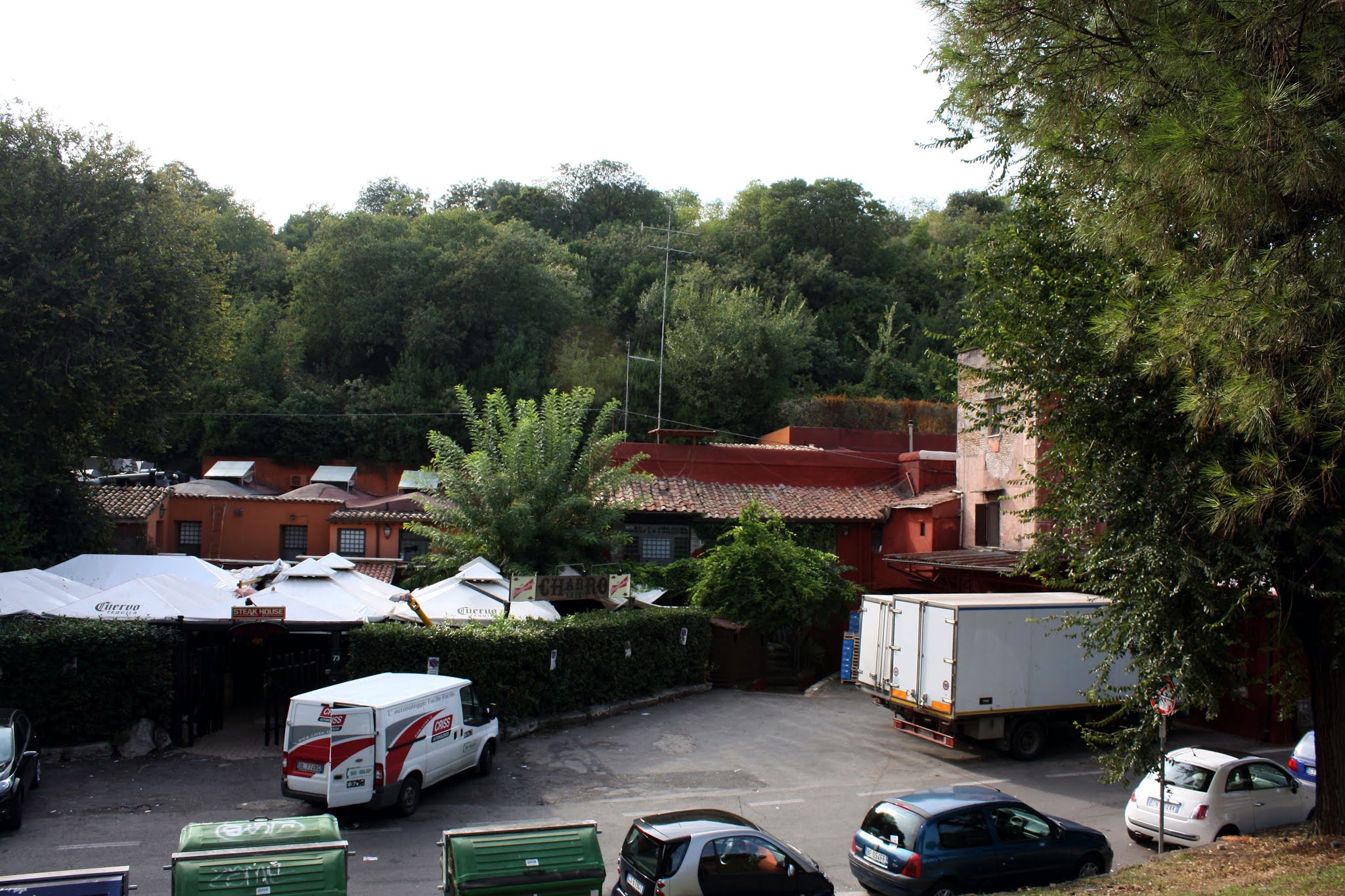 |
| Monte Testaccio (in the background), Rome. Photo credit: © David Gill |
Why I included the word 'reeks' ...
We think immediately of synonyms such as 'smells' or 'stinks'. The word we know as 'reek' has an interesting etymology, linked to the Old Irish word, 'cruach', which leads on to the more familiar 'rick' (think: hayrick), implying a pile, mound, stack or stook.
Monte Testaccio, as I have mentioned, is composed of stack on stack of cast-aside amphorae. Most if not all of these clay vessels would have contained olive oil, surely one of the purest kinds of food imaginable. 'Purest', that is, until it turns rancid. Olive oil was not only a significant part of the Roman diet; it was also a useful commodity in terms, for example, of lighting and medicine.
I was perhaps influenced at the time of writing (and this poem was first published way back in 2003) by an increased awareness of the growing practice of 'taking things to the tip' or civic amenity site, with its mountains of landfill waste and accompanying odours. By this time I would have encountered the Tucson Garbage Project through conversations at the British School in Rome and through reports. My pot-washing activity in the 'Camerone' (a spacious archaeology room) at the School may not have been particularly challenging in terms of smell, but the water could look pretty grimy with washed-off sediment!
Perhaps at this point I should mention ‘garum’, the famous fish sauce, a popular and pungent part of Roman cuisine. There is a link here to an article attributed to Jason Daley on the Smithsonian website about it (and its presence in Israel).
It seems unlikely, at least from my reading on the subject, that amphorae containing garum were placed on the Testaccio mound. However, I find it interesting that Dr Elizabeth Bartman (of the archaeo-culinary Elifant Tours) specifically mentions potsherds found on Testaccio from Baetica, in what we would know as the south of Spain, 'most with olive-oil residues but some with traces of fish'.
Professor
Amanda Claridge, who was Deputy Director of the British School at Rome during
our year as residents, seems less convinced, however, that there is evidence for amphorae containing garum on the Testaccio site. In her book, Rome
[1998] in the Oxford Archaeological Guides series, she asserts on p.367 that
the surface of the mound ‘consists almost entirely of olive oil amphoras’,
dating from 144 AD (with the exception of a slightly earlier sherd) to the
middle of the third century. Professor Claridge points out that 'a core of
older material must lie deeper in the hill'. Who knows what may yet come to light.
An article, 'Trash Talk' (Jarrett A. Lobell), in Archaeology, seems to suggest that there is currently no evidence for a (separate) mound anywhere in Rome comprising amphorae filled with garum. Professor Claridge indicates that there is scope for further study since commodities other than 'oil amphoras' must have 'passed through the port' of Rome.
And finally we come to the last line of my poem. I decided to stick with the traditional form of the word 'perfect' in relation to feline taste (culinary and otherwise); but I can't say I wasn't tempted to insert an 'urr' in place of the more conventional 'er' spelling!
*
Also consulted: David Peacock and D. F. Williams Amphorae and the Roman Economy: An Introductory Guide (Longman 1986).
My thanks to Maria Lloyd for setting me this task.
The next post in this mini-series concerns my poem, 'Wildfire', on p.31 of Driftwood by Starlight.