Showing posts with label archaeology. Show all posts

Monday, 19 July 2021

'Driftwood by Starlight' in Cornwall: (2) The Penwith Moors


I have loved the moors in West Penwith for many, many years. The air is clear and there is a feeling of being almost surrounded by the sea, as it laps around edges of the peninsula below. The wide open spaces (no crowds up here, as you can see!) give rise to a sense of history and prehistory. 


Archaeologists and others have long mused over the meaning of the holed stone of granite in the photograph, a stone that has clearly been associated with different purposes at different times in its long existence. I expect a good number of sheep, and possibly cattle, have rubbed up against it over the centuries. The Cornish name for this monument (see signpost above) means simply 'stone with hole'. The orange arrow points to the monument.


You can see one of my favourite tin mine pumping engine houses (over the Greenburrow Shaft) from here. 

This particular mine has a very memorable name. My short poem about it features in my new first full collection of poetry, Driftwood by Starlight, published by The Seventh Quarry Press in Swansea, and available at the UK price of £6.99.


Tuesday, 12 August 2014

Reading my Stonehenge Poem at Walpole Old Chapel


David and I joined other East Anglian poets for the annual Poetry Evening at Walpole Old Chapel. We were wondering whether Hurricane Bertha would prevent us from reaching this lovely and remote corner of Suffolk, but all was well and we were treated to some wonderful poetry, glasses of elderflower cordial and slices of Queen Mother's cake. Our thanks to Mike Bannister and all those who helped to make the evening such a delightful occasion.

In the light of a recent visit to the re-vamped Visitors' Centre at Stonehenge, I read my bluestone poem, 'Preseli Blue', which features in my recent chapbook, The Holy Place. The poem was first published in The Lie of the Land (ed. Jan Fortune, Cinnamon Press).


'Preseli Blue' was read on BBC Poetry Please as part of the programme from the Hay Festival in 2008. It was written in response to the rope-bound Millennium Bluestone on display in the National Botanic Garden of Wales. You can read the text here by scrolling down on the Shabdaguchha site. 

On our recent visit we arrived at Stonehenge too late in the day to contemplate a ride up to the stones themselves, though we much look forward to doing this. There was plenty to see at the Visitors' Centre, including a few 'retro' des-res huts ...

With David Gill

... and this rope-bound (model) stone that you could try to pull!


Needless to say all efforts proved useless!


We enjoyed watching the land-train, but I can't help reminiscing about my early visits to the site in the 1960s when we used to take the dogs and wander at will.


Storm clouds were brewing. It was time to beat a hasty retreat.


Tuesday, 11 March 2014

Anthology Alert ~ Orizont Literar Contemporan Antologia from Romania

Editor-in-chief Daniel Dragomirecu

My copy of the Antologia for Orizont Literar Contemporan | Contemporary Literary Horizon arrived today from Romania. This publication opens with a sequence of poems by Peter Thabit Jones, editor of The Seventh Quarry, from Wales. It also features my interview with Martin Locock, editor of the new anthology, Poetry from Strata Florida, produced by Carreg Ffylfan Press (2014). 

I am grateful to Iulia Andreea Anghel at the University of Bucharest for her translation, '1 Mai: Zmeu Roşu în Strata Florida', of my poem, '1st May: Red Kite at Strata Florida'. 


Saturday, 18 January 2014

Poetry at Sutton Hoo ~ a Day with Dr Sam Newton on Beowulf

Model of the Sutton Hoo helmet ...

I spent today at Sutton Hoo, site of the incredible Anglo-Saxon ship burial. The site is in the care of the National Trust. The study day, 'An Introduction to Beowulf and Sutton Hoo', was put on as part of the Wuffing Education scheme by Dr Sam Newton, who has written extensively on the subject.

It was an excellent way to spend a January Saturday, and I came home wanting to read Seamus Heaney's translation of the tale and hoping to re-watch the Michael Wood programme, 'In search of Beowulf' (which I believe is only available on YouTube). I also want to explore some of the Anglo-Saxon landmarks in my locality.


This is the framed view of the site, looking down from the level of the mounds to the River Deben in Woodbridge. 


This was my view as I came out from the Old Court to go home. You can make out one of the burial mounds between the trees. 


Thursday, 31 January 2013

Published Poetry: The Holy Place ~ Reviews


I am delighted to have two reviews this week of The Holy Place, my poetry chapbook co-authored with John Dotson, who lives in California. The commissioned chapbook is the fifth in the Poet to Poet series, published by The Seventh Quarry (ed. Peter Thabit Jones in Swansea, home town of Dylan Thomas) in conjunction with Cross-Cultural Communications (ed. Stanley H. Barkan in New York). 
The first review by Juliet Wilson (who blogs as Crafty Green Poet), editor of Bolts of Silk, can be found here. There is also a version of this review on Juliet's page in GoodReads. I have just noticed another related post by Juliet here, on the subject of Italian feral cats, who feature in my poem, 'Monte Testaccio: Mound of Potsherds'. 
The second review, by Ian Griffiths, has appeared in Twelve Rivers, the publication of the Suffolk Poetry Society. 
I will post a line from Ian's review here ...
“For anyone who has a close involvement and appreciation of nature, place and history, this is an inspiring collection."
Ian Griffiths, Editor of 'Twelve Rivers', publication of The Suffolk Poetry Society, 2013
If you would like to purchase a copy of The Holy Place (£3.50 inc. UK p&p), please contact me via the email here
Do take a look at (and 'LIKE') the new Facebook page for the Suffolk Poetry Society. The Twitter feed is at www.twitter.com, where you can search for @SuffolkPoetrySo or 'Suffolk Poetry Society'. 

Monday, 29 October 2012

Poets on Poet: Matthew Hollis on Edward Thomas

Matthew Hollis

I have been thoroughly gripped by 'Now All Roads Lead to France' by Mattthew Hollis. It is an excellent study of the years and days leading up to the Great War. I have almost finished the book, and was delighted to have the chance to hear Matthew presenting his subject in an illustrated talk for the Suffolk Poetry Society.

Book-signing time ...

You will not be surprised to hear that the presentation included 'Adlestrop', a place I visited many years ago on a frosty morning. After Matthew had finished speaking, members of the audience were invited to ask questions and to choose a favourite Thomas poem. David and I selected 'Swedes', a poem we had written about way back in 2003. We ventured to show how this poem emerged from prose. You can find a link to our 'Note' in OUP Notes and Queries here.


'Adlestrop - The name' Edward Thomas

Thursday, 10 May 2012

News and Views (1): Norwich ... not just 'A Fine City'

Pull's Ferry, with Norwich Cathedral behind
Having lived in Swansea, which was chosen to host the UK Year of Literature and Writing (1995), for nearly 20 years, I now find that Norwich, a short train ride away and the home city of my teenage years, is the new UNESCO City of Literature!
Caistor St Edmund, Norwich
On the train journey home from Norwich today, I took this photo of Venta Icenorum, the Roman town and one of the regional capitals of Roman Britain (can you see the square of the outer walls?). The village is now known as Caistor St Edmund: it is a place I knew well from my Norfolk childhood, but I had never seen the Roman walls so clearly before. The tower-like structure towards the left is Bastion 7136.

Thursday, 26 April 2012

Event Alert (1): Raiders of the Lost Art at UCS with David Gill


Philadelphia, Jan. 2012: David Gill receives his Outstanding Public Service Award

If you live within range of Ipswich, you might care to join us on Wednesday 2 May. As part of the UCS Academy Lecture series, David Gill (my husband) will be discussing his research on collecting antiquities. The evening, entitled 'Raiders of the Lost Art' and hosted by Mark Murphy of BBC Radio Suffolk, will take place at the University Campus Suffolk Waterfront Building in Ipswich, starting at 17.30 with registration and refreshments and closing with a canapé reception from 19.30.

We very much hope you will be able to join us for this event. If you would like to come, it would be appreciated if you would reserve a place: further details can be found here on David's Looting Matters blog and here (with contact email) on the UCS website.

You may also be interested to hear of David's recent appearance in The Independent's 2012 list of '100 People who make Britain a much, much better place' for his work on returning looted antiquities.

Outside the UCS Waterfront Building, Ipswich, venue for the event on 2 May

Wednesday, 25 August 2010

Magazine Moment (16): Cultural Horizon Magazine (Romania)


You can enjoy the vibrant 'buzz'

of Van Gogh's famous Sunflowers
here

I was delighted to receive the current copy of Contemporan Orizont Literar (Annul III - Nr.4 (18) / JULY-AUGUST 2010) through the post from Bucharest. Mihai Cantuniari is Director of this international and largely multi-lingual publishing enterprise, with Daniel Dragomirescu as Editor-in-Chief. The magazine's new Foundation is a media partner of MTTLC, which comes under the guidance of Professor Lidia Vianu at the University of Bucharest.

GOOD NEWS! ... Members of the magazine's editorial and production team have secured a national headquarters in Bucharest. The new Foundation is now on track. Daniel and his colleagues have persevered to ensure that the magazine goes from strength to strength, rising to new heights and inspiring readers (and writers) from all corners of the globe. I am not alone in acknowledging a debt to the editor's cultural foresight.

A package from Romania!

The arresting and penetrating eyes of Van Gogh, in his self portrait 'without beard', adorn the front cover of this issue. I cannot help feeling that the portrait complements the poem on p.16, After Kirchway after Keats by Professor Donald Riggs of Drexel University, Philadelphia, USA. I have no idea whether the painter's depressive and suicidal traits were manifested in a previous generation, but I find myself substituting 'brother' for 'sister'* in Van Gogh's case. The poem poses - as perhaps all good poems should - more questions than it attempts to answer, concerning our genetic and social make-up as individuals. I found myself reconsidering the old chestnut of whether art arises in its most potent form out of suffering - or whether suffering is just one of many valid catalysts for creativity.

This fine poem by Riggs is, of course, not about Van Gogh but about Keats. A picture of the poet lodged itself in my head back in 1985, when I lived in Rome, and paid my first visit to the Protestant Cemetery by Piramide (named after the eye-catching Pyramid of Cestius), to see those paradoxically ethereal and immortal words of epitaph etched in stone. Since then my vision has mutated somewhat, and it would be fair to say that the Keats of Bright Star is probably the dominating picture today - such is the power of story, reconstruction and (perhaps especially) the moving image.

Curiously, this issue has more of Keats on p.50. Swansea poet, Byron Beynon, evokes the interior of the Keats-Shelley House at 26 Piazza di Spagna, in his poem, The Spanish Steps, Rome. The poem includes the chilling line, 'death entered at eleven o'clock'.

Speaking of Wales, you will find my interview with Cardiff eco-poet, Susan Richardson (and here), on p.4 - along with Susan's polar poem, Waiting at the Breathing Hole, about life above and below the ice, in which the speaker waits expectantly for 'the whiskered nose of inspiration'. The poem is from Susan's acclaimed poetry collection, Creatures of the Intertidal Zone, published by Cinnamon Press. Thank you, Susan, for your detailed answers to my snow-shower of questions! Incidentally, you can read about Susan's recent visit to Keats' House in Hampstead, UK here.

This edition contains 60 packed, illustrated and well presented pages of:
  • Articles and Features (e.g Deborah Ann Erdmann, USA on There's No Place Like Home)
  • Poetry (p.8-11, 16-18, 21-22, 25-26, 30-31, 34-36, 43-48, 50-55, 59)
  • Contemporary Perspectives and Horizons (e.g. Peggy Landsman, USA; Iorgu Gălăţeanu, Romania; Maria Eugenia Mendoza Arrubarrena, Mexico)
  • Photographs and Illustrations (throughout)
Thank you once again, Daniel, for the opportunities that have arisen - opportunities to make new friends, to gain fresh perspectives on the multi-faceted world of the Arts, and to learn more about Romania itself.

This edition is truly 'international' in outlook. The following countries are represented by those who have contributed:
  • Romania
  • USA
  • Germany
  • Chile
  • India
  • Bulgaria
  • Nigeria
  • Spain
  • Mexico
... and Wales, including a page of Lyrical Horizon | Orizonturi Lirice poems by Chris Kinsey. I interviewed Chris, BBC Wildlife Poet of the Year 2008, in an earlier edition in my occasional column, Dialoguri Galeze.

Do take a look at the magazine site here. New subscribers are always welcome.
  • MAGAZINE PRICE: 12 EUROS | 15 DOLLARS PER COPY (SHIPPING INCLUDED). PayPal details to the right of the magazine page if you click here.
* A letter from Keats to his sister, Fanny


Friday, 30 July 2010

Ars Poetica (2): Ekphrasis


Leicestershire: Grace Dieu (above)
and nearby Coleorton (St Mary's Church below)


Wordsworth was influenced artistically
by his patron, Sir George Beaumont,
who played a key role in the founding of the National Gallery in London

and lived at Coleorton Hall


I have had cause on two recent occasions to consider the nature of ekphrastic work, so I thought it might be a useful moment to formulate some (personal) thoughts and air a couple of queries on the subject.

From my undergraduate studies of Classical Greek, I know that ek corresponds to out, and phrasis to speak. We find ek or ec in English words like ectoplasm. We also find it transmuted to ex in words like external. We know phrasis, of course, from words like phrase and phraseology. Ekphrasis, a rhetorical technique, is therefore a combination of these word-parts, which when combined give a meaning of speaking out or proclamation - or to put it another way, of calling 'an inanimate object by name' [Wikipedia - see also a number of definitions garnered by Ryan Welsh at the University of Chicago].

The majority of ekphrastic poems (I believe) shed light on a picture without the two art forms being physically conjoined. They do, however, build an imaginary bridge between the 'verbal' and the 'visual'. Take, for instance, the iconic example of Keats' Ode on a Grecian Urn. What is important here is that the poet brings a 'notional' or 'allusive' - rather than an 'actual' - image before our inner eye and makes us question what we visualise. There is no need for us to see the urn (which may or may not be a single artefact) portrayed in a given medium alongside the poem. The words alone do the work, conjuring up the object in our imagination.

We occasionally encounter ekphrasis in poetry as an actual and symbiotic pairing of word and image. That is to say, for example, that a poem text and piece of corresponding 'visual art' work in tandem to form a fusion or new creation. The one art form elucidates and illuminates the other in some manner - and this is a two-way process. We can all recall our childhood story and poetry books in which the bold and colourful illustrations added so much to each tale or poem. I consider this powerful marriage to be ekphrasis at its most basic (and on occasions at its most potent) level.

In these multi-media days of collaborative enterprises and opportunities, we are familiar with countless instances of art forms impacting on other media. Ekphrastic poetry could be 'illuminated' or 'enhanced' (I hesitate to say 'illustrated') by 'actual' painted work, pen-and-ink drawings or photographs. It may be of interest to note that a union of photography and poetry has appeared in the Poetry Book Society bulletin as Photoetry, but I see this as a form of ekphrasis rather than as something different again.

The questions lingering in my mind are ones of definition and distinction:
  • Are all 'visual' poems ekphrastic?
  • Are all 'illustrated' stories (like those in the children's picture books mentioned above) ekphrastic?
And in each case, if not, then why not?

* * *

Previous Coastcard posts touching on Ekphrasis can be found here and here. My Photoetry entry (with a couple of book recommendations) is here.

You may also like the following:

Wednesday, 9 June 2010

Archeological Avenues (4): OUP - HMS Belvidera and the Temple of Minerva

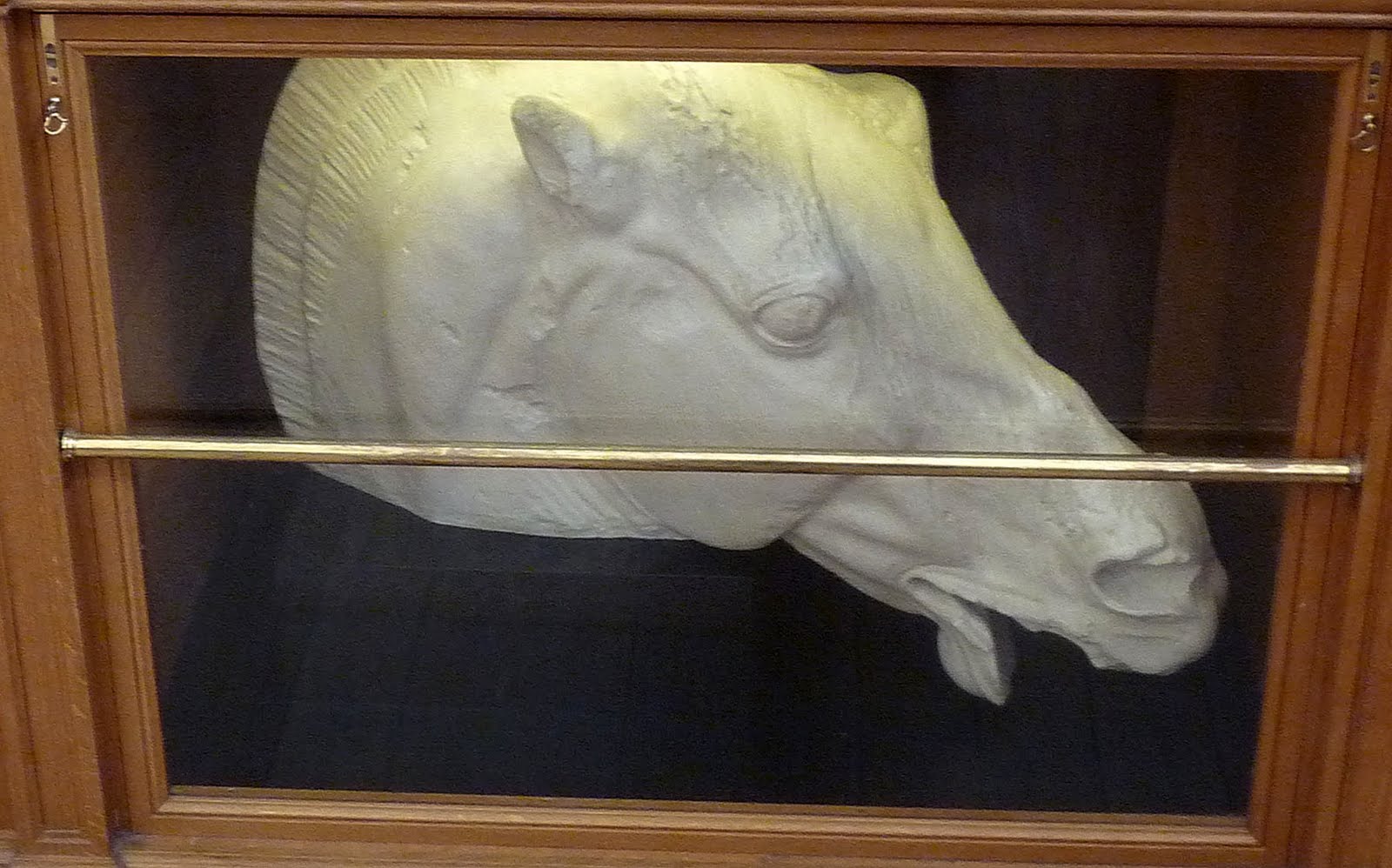
Cast of the 'Horse of Selene'
British Museum

David (Gill) and I have just received our offprints for our joint piece, HMS Belvidera and the Temple of Minerva, published by Oxford University Press in Notes and Queries. The print journal came out in June.

We consider the iconographical details on a marble book, and link these to HMS Belvidera and the Parthenon around 1832, when King Otto was crowned ruler of Greece. You may like to read my blog post here.
  • D.W.J. Gill and C. Gill, 'HMS Belvidera and the Temple of Minerva', Notes and Queries, Vol 255 of the Continuous Series [New series, Vol. 57], No.2 (June 2010): 199-210
N.B. 'Notes and Queries Advance Access' scheme: you can login via Athens if you are part of an academic community.

Tuesday, 8 June 2010

Carnival Time (8): Guardian Hay Festival

More Images
from the Guardian Hay Festival 2010

N.B. Wordle to right...


Above
The Wiggly Worm Garden
'Relax Explore Learn Enjoy'
Wiggly Wigglers is an award-winning natural garden company


Above and below

Magnetic Butterflies
winging messages from individuals
in the SkyArts Tent

We had fun decorating our butterflies...
... and even more fun trying to get them to stick to the mesh on the roof!


Below

The Swimming Reindeer

Late Magdalenian, approx. 12,500 years old.
Provenance: rock shelter of Montastruc, Tarn et Garonne, France
British Museum

We so enjoyed the inspirational event by Neil MacGregor,
Director of the British Museum,
on his Radio 4 series,
'A History of the World in 100 Objects'

After the talk we were able to handle a few objects, like this remarkable piece.


All in all, it was a great day out...
and even the weather was glorious!

Monday, 24 May 2010

Magazine Moment (9): Cultural Horizon Magazine (Romania)

Cause for Celebration!

Contemporan Orizont Literar | Contemporary Horizon Magazine
from Bucharest, Romania

I have just received the latest copy of Contemporan Orizont Literar | Contemporary Horizon Magazine from Bucharest, Romania. This special issue, 'Anul III, Number 2 (16)', is packed with cultural delights from Nigeria ('Nigerian Perspectives' by Biola Olatunde on p.36) to Sri Lanka (poems by Sayumi Yokou on p.58) and Uruguay ('Belonging', on life as a student at Montevideo on p.59) by Marcela Meirelles.

This is a special edition because...

1) it marks the second anniversary of the magazine in its current format. It was founded a year ago in May 2008 by Mihai Cantuniari, with Daniel Dragomirescu as Editor-in-Chief. I first came across the magazine on the American site for writers, 'The Red Room', having read about the magazine in a blog-post by contributor, Peggy Landsman. Since then I have submitted a batch of my poems, which were published bilingually in English and Romanian, thanks to the translating skills of Professor Lidia Vianu's students at the University of Bucharest. I have also set up a series of interviews from Wales, my 'Dialoguri Galezi', in which I interview poets and other writers about their work.

2) it coincides with the official launch in Bucharest of the magazine's new 'Contemporary Horizon Multicultural Foundation'. This is an exciting time as the magazine takes off and becomes more widely read all over the world. I have been very stimulated by the international exchange of culture, literature, art, ideas and news. You can imagine how thrilled I was to receive the certificate, posted above!

The special issue opens with a 'flashback' or résumé of what has happened in the last year. Daniel Dragomirescu ('From Creative Localism to Multiculturalism' p.4) charts the developments of the new magazine, and explains how it was initially conceived as a sequel to the Vaslui Literary Truth magazine | Adevărul literar din Vaslui.

Contemporan Orizont Literar | Contemporary Horizon Magazine has come along way in the last two years. Since April 2009 the magazine has become an independent, bilingual and multicultural magazine. I interviewed Swansea poet, Byron Beynon, in one of my 'Dialoguri Galezi' slots; and the poem he supplied to accompany his answers was printed not only in Romanian (thanks to the input of Professor Lidia Vianu and her students enrolled on her Masters course on the Translation of the Literary Text) and English, but also in the Welsh language. The magazine had been partially bilingual up to and including issue no.3 in July 2009, but now all features appear in Romanian and English. Alina-Olimpia Miron, one of the main translators, has now taken on the role of General Editorial Secretary. I am personally indebted to Alina for her translation work.

You need only to click on the Contemporary Horizon link to see from the representative flags just how many corners of the world have already been touched by the electronic versions of magazine features. Many contacts have been made via the internet in this way.

The current issue is packed with the following ('in no particular order'):
  • poetry (e.g. from [1] Charles Johnson, UK editor of Obsessed with Pipework magazine; [2] Tanka (by Alan Segal, USA)
  • interviews (e.g. [1] Ioana Ireonim asks Professor Lidia Vianu about her translation work in Romania; [2] I interview my husband, David Gill, about literature and Mediterranean archaeology),
  • a Welsh profile (Byron Beynon looks at the letters sent by R.S. Thomas to Raymond Garlick)
  • short stories (e.g. 'Jasmine Fragrance' byMaria Dolores garcia pastor from Spain)
  • features (e.g. on 'Writers and Writing' by Professor Do Riggs, USA)...
... and a great deal more besides. The magazine has a coloured cover. There are black and white photographs and illustrations throughout.

Do consider taking out a subscription by PayPal (details here). You can read more about the magazine here and here - and you can always leave a comment on the Contemporary Horizon site, if you feel you would like to make a response.

On a personal note...

... I would like to end this round-up with words of very sincere thanks to my friends in Romania. I would like to express my personal gratitude to you all. Thank you, Daniel and Alina, in particular, for your friendship and opportunities for collaboration over the last year or so. It has meant a great deal to me. Thank you, too, for the splendid certificate. I wish you well and look forward to further cultural collaborations in the days ahead.

Wednesday, 19 May 2010

Publications (2): OUP Notes and Queries

Cast of the 'Horse of Selene'
British Museum

I mentioned in my last post that I had been paying a visit to the British Museum. It was good to see this cast of the 'Horse of Selene'. The original horse comes from the east pediment of the Parthenon. Benjamin Robert Haydon was one of the first artists to study the anatomical details of the marbles once they arrived in London. He described the 'Horse of Selene' in these words:

'a perfect example of what the highest genius will do,
when curbed and guided by science.'

David (Gill) and I have just been told that our joint piece, HMS Belvidera and the Temple of Minerva, was published on 20 April 2010 via the Oxford University Press 'Notes and Queries Advance Access' scheme.

You can login via Athens if you are part of an academic community. The print journal is due out in June, and will be available to all. We consider the iconographical details on a marble book, and link these to HMS Belvidera and the Parthenon around 1832, when King Otto was crowned ruler of Greece.

  • D.W.J. Gill and C. Gill, 'HMS Belvidera and the Temple of Minerva', Notes and Queries, 57 (2010): 199-210

Monday, 28 September 2009

Competition Corner (2): The Haddon Library of Archaeology & Anthropology, University of Cambridge

Cambridge

The results of the Haddon Library Poetry Competition were announced at a prizegiving ceremony on 25 September 2009, as part of the Alumni Weekend.

800, 1209, 2009 HADDON LIBRARY POETRY COMPETITION


Winning Poems

1st prize: His eightieth (Roger Elkin)

2nd prize: The story of 800 (Mary Courtney)

3rd prize: Sleepover at the Museum (Caroline Gill)

[Click on poem title to read poem or click on poet's name to read about poet, in each case].

The competition was part of the Cambridge 800 celebrations, and poems had to incorporate one of the anniversary numbers - 800, 1209 or 2009. You can read the University of Cambridge Press Release here.

Thursday, 27 August 2009

Published Poetry (2): The Dawntreader

I blogged about Edward Thomas the other day as part of a challenge set by The Weaver of Grass to write a post about a favourite book. In the course of this post, I mentioned a prose piece I had co-authored with my husband, David, some time ago, published in OUP's 'Notes & Queries' about the poem 'Swedes'. Thomas likens the opening of the swede clamp to the discovery of an Egyptian tomb. He alludes to tomb robbers, and to the array of glittering treasure.

How curious that I should open this morning's post to find my poem, 'Gold', about tombaroli in the Etruscan tombs of Italy, in the latest edition of The Dawntreader, published by Ronnie Goodyer and Dawn Bauling of Indigo Dreams Press.

Tuesday, 23 June 2009

Tuesday, 14 April 2009

Language & Linguistics (3): Translation

The book in Rudston Church
(please advise if this is not the right way up)

Most writers, I imagine, must wonder at one time or another about translation. My poems have occasionally appeared in international anthologies (e.g. from India and the USA); but to my knowledge, none of my poems has been translated into another language. Who knows what the future will hold. Works like Homer and Shakespeare, of course, have appeared in countless tongues. I came across a useful site concerned with translation, and I also found it interesting to read about the eighteenth century views of Samuel Johnson (click link and read 'A thought for the day').

You may wonder what sparked this train of thought. I was recently at Rudston Church near Bridlington, visiting the grave of the novelist, Winifred Holtby (and also looking at a gigantic menhir in the churchyard and reading the memorial tablets to my distant MacDonald ancestors). As we entered the church, my eyes alighted on a delightful copy of South Riding ... translated into Japanese by Suzoku Sakamoto.

Thursday, 12 March 2009

Archaeological Avenues (1): Stunning Photography from Aberdeen

You can see the Finalists' Gallery of a recent photographic competition organised by the Department of Archaeology at the University of Aberdeen. I wish I had found this site sooner!