Showing posts with label Peter Thabit Jones. Show all posts

Monday, 1 January 2024

'World Poetry Anthology' edited by Hassanal Abdullah


David Gill and I are delighted to be included in this new anthology of poetry from across the globe, compiled and edited by Hassanal Abdullah to mark 25 years of his international poetry journal, Shabdaguchha.

This volume published by Darklight Publishing (New York and Mexico) features, among many others, poems by Pablo Neruda, Aeronwy Thomas, Stanley Kunitz, Peter Thabit Jones (poet, writer and editor of The Seventh Quarry Press), Louise Glück and Lidia Chiarelli.  

You can buy the anthology here

David's poem is a nod to Edward Thomas. My poem, 'Preseli Blue', concerns a bluestone from Stonehenge and was triggered by the sight of one of these boulders on display in the National Botanic Garden of Wales, way back in 2001.  

Previous post: click here.

Wednesday, 15 September 2021

'Driftwood by Starlight' ... Posts Relating To My Poetry Collection


When Driftwood by Starlight, my first full poetry collection, was published by The Seventh Quarry Press in June 2021, Maria Lloyd (@mariatlloyd), a research student at the University of Reading, set me some questions about a number of the poems, and particularly about those that relate to the Ancient World in one way or another.

You can find my responses in blog posts (1) to (3) below. I hope you will find something of interest if you click on the links.

(1) Questions from Maria Lloyd here. A post on 'Monte Testaccio, Mound of Potsherds', p.35.

(2) Questions from Maria Lloyd here. A post on 'Wildfire', p.31.

(3) Questions from Maria Lloyd here. A post on 'The Ocean's Tears', p.24 and 'Ice-Blue Blood', p.25.  

 • • •

While I was in Cornwall earlier in the summer, I took the opportunity to re-visit some of the settings in the book. Posts (a) to (c) below refer to these. 

(a) Cadgwith on The Lizard peninsula, setting for 'The Serpentine Stile', p.9. See here.

(b) The Penwith Moors and Mên-an-Tol, setting for '(W)hole Thoughts from Mên-an-Tol', p.28. See here.

(c) Zennor, setting for 'Zennor Voices', p.19. See here.

Tuesday, 31 August 2021

DRIFTWOOD BY STARLIGHT: Questions from Maria Lloyd (3)

Reconstruction (Piet de Jong) of floor motifs, Throne Room, Nestor's Palace, Pylos
 

Driftwood by Starlight, my first full poetry collection, was launched online on Tuesday 3 August. The book was published in June 2021 by Peter Thabit Jones of The Seventh Quarry Press. It can be purchased for £6.99/$10 from the publisher's online shop here.  


Maria Lloyd, who holds a Masters degree on The City of Rome from the University of Reading, read the collection and decided to set me some questions. I am attempting to provide a few answers in this mini-series (without giving too much away ...). Thank you, Maria. 

Post One (click here) concerned my poem 'Monte Testaccio, Mound of Potsherds' on p.35 of Driftwood by Starlight.

Post Two (click here) has as its focus the poem, 'Wildfire', on p.31. 

This is Post Three, and we stay with an archaeological theme as we switch our focus from the Roman World to Ancient Greece.

Let's turn to Maria's question. It relates, of course, to all the poems in the collection; but for the purposes of this post I shall apply it to 'The Ocean's Tears' on p.24 and 'Ice-Blue Blood' on p.25:

'You appear to write on a wide range of topics but what were the triggers that made you want to write about these topics in particular?' 

Many of us have a sense of adventure lurking somewhere inside us, even if in some cases we turn out to be largely armchair travellers. The classical world has fascinated me for decades so it is not surprising that aspects of ancient Greece and Rome surface in my poems from time to time. The Odyssey is a favourite ancient text. 


Homer in hand at Nestor's Palace, 'sandy Pylos', Peloponnese, 2010. Photo: © David Gill

The two poems I mention above were the result of my engagement with 'Homer', the blind bard. How much of the Iliad and Odyssey can actually be attributed to him is debatable since the tales of Troy are part of the oral tradition in which songs were passed on from singer to singer.  


Bust of Homer, Mount Egcumbe

The bust above, photographed in June 2021 during our Cornish holiday, is similar (though not, in fact, identical) to a sculpture of Homer found near Baiae on the Bay of Naples and purchased by Townley (BM Cat. Sculpture 25).

The two poems I consider in this post exhibit similarities and differences. They are not 'a pair', though it was a deliberate choice to place them opposite one another in the collection. Both concern the tale of Troy to some degree. They each have (in my mind at least) a 20th century UK beach setting.

'The Oceans Tears' is a Tercet Ghazal, a form developed by Robert Bly from the traditional (Arabic) Ghazal of Persian origin. I first encountered Ghazals with a three-lined stanza or 'sher' on The Ghazal Page, a web resource run by Gene Doty, which, sadly, is no longer available. 

'Ice-Blue Blood' is also written in three-line stanzas, but (to give words from this poem a new context) there the similarity ends, at least as far as form is concerned.

'The Ocean's Tears' includes a number of items that point to the Homeric world (gold, bronze, arrows and horse). Troy was never far from my thoughts during the drafting of this poem. 


Entrance to the 'Troy: Myth and Reality' exhibition, British Museum, 2019-2000
 

Those who have visited King Agamemnon's citadel at Mycenae will be familiar with the cyclopean walls to which I allude in the third verse.


Mycenae, linked to King Agamemnon. Photo: © David Gill

The Lion Gate entrance to the citadel at Mycenae. Photo: © David Gill

Mycenaean walls, with jeep for scale. Photo: © David Gill

'Ice-Blue Blood', on the other hand, begins with an epigraph from William Cowper's translation of Homer about a many-legged creature. I have long been intrigued by artistic renderings of octopus and squid in the Ancient World (see assorted examples on Greek pottery below), and have wondered whether these representations have any symbolic meaning beyond the visual. I believe I read that in one part of the ancient Greek world, the octopus motif could have been applied as a kind of early trademark, but I would need to explore this further.


Octopus fragment found at Phylakopi, Melos (Fitzwilliam Museum)

Octopus (9), Metropolitan Museum of Art, NY (early 20th century reproduction of stirrup jar, Crete)

Octopus in the 'Troy' exhibition, British Museum

Amphora from Tholos tomb II at Routsi, Archaeological Museum of Chora, near Pylos

The octopus was a popular part of the so-called 'Marine Style' of pottery, which originated on Crete in the late Bronze Age and was embraced by potters on the mainland. Monsters, some more cephalopod-like than others, abound in Greek mythology. They are not all creatures of the sea. The Hydra, which appears in a number of myths and sources such as Hesiod, had several heads. Cerberus, or Kerberos, the hound referred to but not actually mentioned by name in the Iliad, had two, three, or even 'many' heads. 


The first open lecture I attended as an undergraduate at Newcastle University in 1979 was given by Dr John Pinsent of Liverpool University on the unusual theme of ancient art and cephalopods. He had authored a paper called The Iconography of Octopuses: a First Typology (BICS 25, 1978) about the development of octopus representations in late Mycenaean vase painting. 


More recently I came under the influence of a large blue graffiti octopus known locally as 'Digby'. Digby, designed by John D. Edwards, is part of the Never Ending Mural community arts project in Ipswich and a popular local icon (see here). There may well be a nod to the spirit of Digby in my poem. And, as I hinted earlier, the impact of squid and octopus representations on ancient artifacts should not be overlooked. There is something very fluid, fascinating and changeable about these marine animals. It is worth remembering that while the wine-dark purple colour from the Murex shell (see also here) was prized as a costly dye in Ancient Greece, humans have been writing and drawing with cuttlefish ink, known to us as 'sepia', since times of antiquity. 


Speaking of early writing, I began with a photograph relating to Nestor's Palace at Pylos in the western Peloponnese. It seems worthy of note that large quantities of Linear B tablets were found here. Ironically, these clay tablets were baked, and therefore preserved for posterity, in a devastating fire.

Linear B tablet (a cast, I think), Archaeological Museum of Chora

In his poem, 'Upon a Foreign Verse', George Seferis reminds his readers that Odysseus is a human hero, and as such a very different 'being' from the otherworldly monsters he encounters. Scylla in Odyssey Book XII has twelve feet and six particularly long necks, each ending in a head and three rows of teeth. She makes the Loch Ness monster seem extremely benign. Were Homer's sea monsters inspired by atmospheric shadows whipped up by storms at sea or by sightings of giant octopuses? I guess we shall never know.  

Tuesday, 3 August 2021

'Driftwood by Starlight' Online Launch

Tin-mining country, Minions Moor, Cornwall
 

My first full length poetry collection, Driftwood by Starlight (The Seventh Quarry Press, June 2021), is being launched via Zoom this evening, Tuesday 3 August 2021. 

Driftwood by Starlight can be purchased for £6.99 (UK price) from the online shop at The Seventh Quarry Press website - here.


Peter Thabit Jones, my publisher, will introduce The Seventh Quarry Press. I have invited Peter to read one of his 'Edward Thomas' poems in the first half. 

I will read a selection of poems (East Anglia, Wales, Cornwall ...) from the book. Guest readers, Susan Richarson and Jean Salkilld, will each read one of their poems. David (Gill) will also read one of his poems.

Jean's collection, The Familiar Road, was published by The Seventh Quarry Press in 2016. (The Suffolk poem Jean is due to read is not actually in this collection.)

Susan Richardson's poem comes from Words the Turtle Taught Me (Cinnamon Press, 2018), shortlisted for the Ted Hughes Award

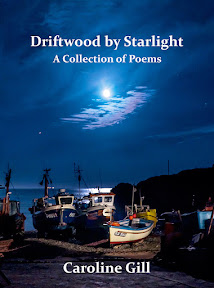
My thanks to photographer, Laurence Hartwell, for his night-time photograph of Cadgwith on the front cover.

Thank you also to Maria Lloyd whose questions about the collection will appear in a future post on my blog ... with my answers! 

Update, 4 Aug 2021: my sincere thanks to Juliet Wilson who has posted a review on her Crafty Green Poet blog here.


My poems included in the online launch:

  • The Serpentine Stile, p.9
  • Zennor Voices, p.19
  • Preseli Blue, p.37
  • Monte Testaccio, Mound of Potsherds, p.35
  • Treasure Hulk p.36 (For interest: the Scallop can be seen here.)
  • The Ocean's Tears, p.24
  • Isabella Tiger Moth Greets the Woolly Bear Caterpillar, p.34
  • Two Penguins and a Pebble, p.44
  • The Ceilidh House, p.16
  • Rhossili: Writing The Worm (extracts), p.38
  • Moonshine, p.27

 I refer to my two 'Edward Thomas' tribute poems. These are:

  • Lost, p.12
  • Dunwich in Winter, p.14

My poem, 'Rhossili: Writing The Worm', was first published in Hidden Dragons/Gwir a Grymus (Parthian Books, 2004) after I had taken part in The Write Stuff, a Disability Arts Cymru initiative. I attended launches at the Hay Festival, Ty Llyn/The Dyan Thomas Centre and the National Botanic garden of Wales. 


'Hidden Dragons/Gwir a Grymus' (Parthian Books) launch at the Hay Festival, 2004

  I have invited ...

Peter Thabit Jones to read his poem, 'The Edward Thomas Stone in Steep' from Peter's new book, GARDEN OF CLOUDS New and Selected Poems. You can read about it and buy a copy here. There are some sample poems here and here.

Jean Salkilld to read her poem, 'At Saint Edmundsbury Cathedral'.

David Gill to read his 'Adlestrop'-inspired poem, 'Gloucestershire in the Negev', first published in The Seventh Quarry poetry magazine (2008). See also here.

I refer to the poem, 'Words' by Edward Thomas. 


Launch day, Tuesday 3 August 2021
 

Caroline in Cadgwith, June 2021

My website: Caroline Gill: Poetry

Find me on Twitter: @coastcard

My chapbook: The Holy Place (2012), shared with John Dotson,  and published by The Seventh Quarry Press in conjunction with Cross-Cultural Communications, New York. John was the first poet-in-residence at the Robinson Jeffers Tor House Foundation in Carmel, California.

Monday, 19 July 2021

'Driftwood by Starlight' in Cornwall: (2) The Penwith Moors


I have loved the moors in West Penwith for many, many years. The air is clear and there is a feeling of being almost surrounded by the sea, as it laps around edges of the peninsula below. The wide open spaces (no crowds up here, as you can see!) give rise to a sense of history and prehistory. 


Archaeologists and others have long mused over the meaning of the holed stone of granite in the photograph, a stone that has clearly been associated with different purposes at different times in its long existence. I expect a good number of sheep, and possibly cattle, have rubbed up against it over the centuries. The Cornish name for this monument (see signpost above) means simply 'stone with hole'. The orange arrow points to the monument.


You can see one of my favourite tin mine pumping engine houses (over the Greenburrow Shaft) from here. 

This particular mine has a very memorable name. My short poem about it features in my new first full collection of poetry, Driftwood by Starlight, published by The Seventh Quarry Press in Swansea, and available at the UK price of £6.99.


Monday, 14 June 2021

A Book in the Hand ... 'Driftwood by Starlight', my new poetry collection


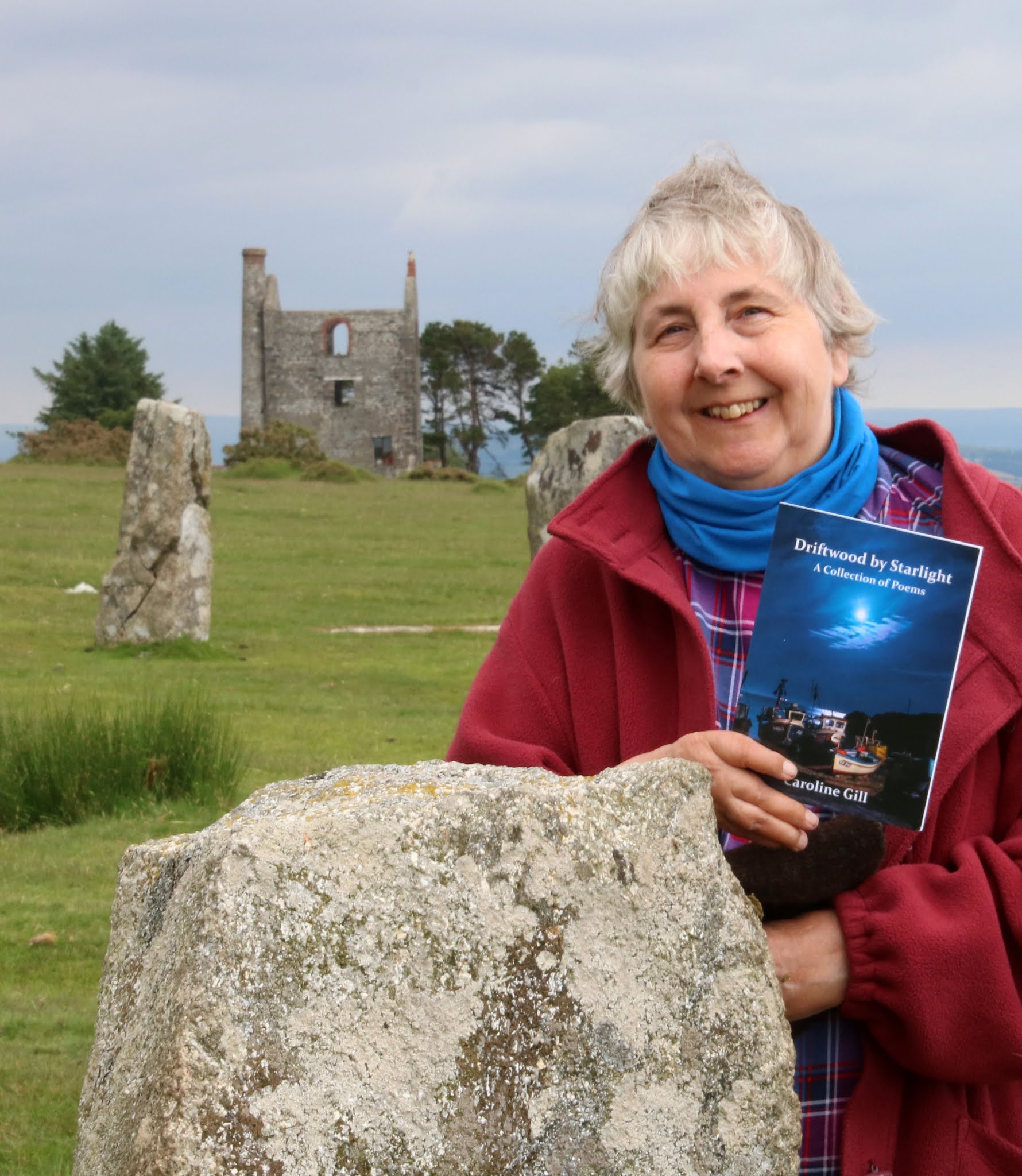
To my great excitement, 'advance copies' of Driftwood by Starlight, my first full-length poetry collection, have reached my Suffolk home today. Here I am holding my first copy, trying hard to keep the 1- and 2-degree burns on my left hand out of the frame! 


Immense thanks are due to Peter Thabit Jones of The Seventh Quarry Press, who has enabled this wonderful day to happen. 

Driftwood by Starlight can be purchased from The Seventh Quarry Press online shop here.

Susan Richardson has generously written the back-cover blurb. The following words will give you a flavour of the collection ...


Saturday, 12 June 2021

Publication Day ... 'Driftwood by Starlight', The Seventh Quarry Press


I am excited and delighted to announce that Peter Thabit Jones of The Seventh Quarry Press in Swansea has just published my first single-authored poetry collection, Driftwood by Starlight. I am immensely grateful to Peter.

The book can be purchased from the online shop on The Seventh Quarry website - here

Fellow poet, Susan Richardson, has written the following words:


Laurence Hartwell generously provided the cover photograph of Cadgwith Cove on The Lizard in Cornwall, UK.  

As it happens, one of my poems in the collection, Elegy for Idris Davies, is currently a Poem of the Month on the SecondLight website here

Thursday, 13 May 2021

Looking Ahead to #DylanDay 2021 ... Immagine e Poesia


Tomorrow is #DylanDay (see here), so I wanted to post some photographs linked to the poet whose hometown of Swansea was also my home for two decades. The water fountain in Cwmdonkin Park in the picture above had a chained cup in the days of Dylan's childhood. 


The park is a riot of colour in spring when the tulips are in flower and the ornamental cherry trees are in bloom. 

Italian poet and Dylan Thomas aficionado, Lidia Chiarelli, charter member and co-ordinator of the Immagine e Poesia movement, has been busy assembling and curating a website of international writing and visual art to mark the day. 

I am delighted to have my poem, 'The Gothic Arch', posted on Lidia's website (do scroll down slowly and read the wealth of new contributions, though the easiest way to find my poem may be to scroll to the bottom here and then move the cursor up the page a little). My poem, as you will see, was written in response to a few words from one of Dylan's poems. 

The site also contains articles, such as one by Peter Thabit Jones on 'Dylan Thomas and Greenwich Village, New York', in which he ponders some of the fascinating 'what ifs' in relation to Dylan's short but extraordinary literary life. 

Do click over to the site and explore some of the features. 

Thank you, Lidia, grazie mille. 


* * *


Lidia informs me that the website event is sponsored by the Metropolitan City of Turin.
Here are the links to the Poets' and to the Artists' sections: the contributions are in order of arrival ...
https://dylandaycelebration.jimdofree.com/poets-for-dylanday/

- 48 Participating Countries on 5 continents
 

102 POEMS/HAIKU

6 VISUAL POEMS

41 ARTWORKS

8 ARTWORKS CONTRIBUTIONS FROM "CIRCOLO DEGLI ARTISTI" - TORINO

5 INSTALLATIONS (PHOTO SHARE)

6 MUSIC COMPOSITIONS

8 ARTICLES/ESSAYS

5 VIDEOS/VIDEO-CLIPS

3 LETTERS


Saturday, 2 January 2021

New Year Greetings (despite everything)


Farewell to 2020

I expect you are also wondering how to wish everyone a happy new year in the light of the past nine months and, indeed, the current situation. Let's hope the vaccination programme really speeds up this coming week, here in the UK at least; and that 2021 will eventually prove to be a bit easier for all.

I am very much looking forward to the publication of my first poetry collection later in the year by Peter Thabit Jones, editor of the Seventh Quarry Press. Meanwhile, I am enjoying my Christmas books, notably Fury (Carcanet) by David Morley and The Christmas Wren (Candlestick Press) by Gillian Clarke.  

I am delighted to find myself included once again on Matthew Stewart's Rogue Strands Best UK Poetry Blogs of the Year list. Thank you, Matthew.


Wednesday, 21 March 2018

Going Global on World Poetry Day, 2018


Happy World Poetry Day, 2018

The image above shows a previous package from India, but a similar one (practically identical but with different stamps) arrived yesterday, containing a contributor's copy of the Golden Jubilee issue of Metverse Muse, an international poetry journal edited by Dr. H. Tulsi. It is always a joy to read poems from different parts of the world and to feel connected in this way. Most issues have offered a Fixed Form challenge: the last one was for a Burns Stanza, a form of Scottish origin, and the new challenge is for a Terza Rima, a form that developed in Italy. 
And this, for me, is one of the joys of poetry, that there are countless influences, methods, techniques and forms (see here for example: I contributed three poems to this Handbook from Lewis Putnam Turco in the USA), spanning not only the centuries but also the globe. 
There is much talk in the present climate about letting down the proverbial portcullis, but poetry enables us to see new vistas through the eyes of another. It encourages us to lower the drawbridge instead, allowing literary influences to flow and circulate. I feel this is particularly important at the present time.
Back in the days when the internet was considered a fledgling phenomenon, I remember starting out one year with a fresh goal. I wanted to have a poem published in an international journal. Since then I have had the privilege of collaborating, albeit mostly in small ways, with poets and editors in Romania, Australia, the Netherlands, USA, Italy and Slovenia, to name but a selection of countries. Most collaborations or communications have been via the internet, but occasionally I have had the privilege of enjoying a face-to-face meeting. 
One such occasion was the launch of the chapbook I co-authored with North American poet, John Dotson. It was arranged by our publisher, Peter Thabit Jones of The Seventh Quarry, at the Dylan Thomas Birthplace, 5 Cwmdonkin Drive, in Swansea. John was over from the USA, and we were able to read our poems together. 

Publisher: The Seventh Quarry (Wales) with Cross-Cultural Communications (New York) 

Another of my multicultural forays in the name of poetry occurred when I was invited to conduct an interview in Philadelphia with Donald Riggs, Teaching Professor of English from Drexel University for Orizont Literar Contemporan, Daniel Dragomirescu's international literary journal from Romania. While I was in Philadelphia, I was also able to spend a day with fellow poet, Kay Weeks. We have collaborated on one or two poetry and art projects, including a charity one, Blossoms of Hope.

with Don Riggs in Philadelphia

A year ago Jongo Park, a visual artist from Seoul, South Korea, supplied a painting of a mermaid as a poetry prompt for me. The paired picture and poem were published in an eBook anthology produced by Italian poet, Lidia Chiarelli of Immagine&Poesia, alongside 94 other contributions from 5 continents and 35 countries. You can download this free eBook (Volume 4) from this site
In these uncertain times, it seems particularly important to celebrate our global community of poets and the immense joie de vivre that this ancient art can bring to the modern world.
And if you are wondering why the top photo is not of the actual parcel that arrived yesterday, well, in my haste to preserve the Indian stamps for the work of TLM (The Leprosy Mission), I made rather a mess of the packaging!

Friday, 17 February 2017

Poet Profile: The Seventh Quarry Poetry magazine

Leaving Ellis Island and Liberty Island, New York, 2013
Issue Twenty-Five of The Seventh Quarry has just been published.

It hardly seems possible that this poetry magazine from Swansea has reached its quarter-century of issues already. Editor Peter Thabit Jones has worked with tireless enthusiasm to make the magazine the eclectic and international publication it is today. Thanks are also due to Stanley H. Barkan of Cross-Cultural Communications in New York, who has collaborated with Peter from the outset, and to Vince Clemente, the magazine's Consultant Editor in America.

The current issue contains contributions from America, Wales, Israel and Czechoslovakia, to name but half the places mentioned on the back cover.

I feature in the Poet Profile slot in this issue, along with four of my poems - including one about Ellis Island, hence the picture above from my visit to this unusual destination in 2013.

The issue includes the poem, 'Oasis', by Jean Salkilld. This poem about Syria is particularly poignant at the present time. Jean has just brought out her first full collection with The Seventh Quarry Press - The Familiar Road, which I am reading which much enjoyment.

If you would like to take out a subscription to The Seventh Quarry, details can be found on Peter's website here

And finally... back in 2012 Peter published my Poet to Poet chapbook, The Holy Place, co-authored with John Dotson: I am posting a picture of the cover.

The Holy Place


Friday, 22 May 2015

StAnza Map - Poems about Scotland


Thanks to Eleanor Livingstone and her fellow poets in Scotland, my Lewis Chessman poem has just been added to the StAnza poetry map of Scotland, and you can find it here.

In 2014 during Scotland’s Year of Homecoming, StAnza set itself the challenge to see if the shape and nature of Scotland could be drawn entirely in poetry. The map continues to fill up with poem-flags, which you can see here.  

My poem, 'Lament of a Lewis Chessman' was first published in my chapbook, The Holy Place, co-authored with John Dotson, and published by The Seventh Quarry (2012) in conjunction with Cross- Cultural Communications (New York).


Monday, 23 March 2015

Poetry Wivenhoe Reading - Come and Join Us!


My thanks to Poetry Wivenhoe for this invitation. I shall be reading from The Holy Place (with a few other poems thrown in). Do come and join us if you are in the area.

Tuesday, 29 April 2014

Update from Romania ~ Orizont Literar Contemporan

Daniel Dragomirescu in the centre

Orizont Literar Contemporan continues to go from strength to strength. Daniel Dragomirescu, Romanian-based editor-in-chief of this international literary journal with the strapline, 'all the world in a magazine', has written an updated account of the story so far. You will find his account here.


The photo above shows me interviewing Donald Riggs, Teaching Professor of Creative Writing at Drexel University, when I was in Philadelphia in January 2012. The interview appeared shortly afterwards in Orizont Literar Contemporan.  

There was an excellent feature recently on a dozen Scottish poets, and more recently still, I have been delighted to find work by my publisher, Peter Thabit Jones (The Seventh Quarry Press, Swansea) in addition to poetry from Gillian Clarke, the National Poet of Wales, and Owen Sheers, Welsh poet, author and scriptwriter.

If you would like further information about the journal, please leave a comment here or contact Daniel via the website.

Thursday, 31 January 2013

Published Poetry: The Holy Place ~ Reviews


I am delighted to have two reviews this week of The Holy Place, my poetry chapbook co-authored with John Dotson, who lives in California. The commissioned chapbook is the fifth in the Poet to Poet series, published by The Seventh Quarry (ed. Peter Thabit Jones in Swansea, home town of Dylan Thomas) in conjunction with Cross-Cultural Communications (ed. Stanley H. Barkan in New York). 
The first review by Juliet Wilson (who blogs as Crafty Green Poet), editor of Bolts of Silk, can be found here. There is also a version of this review on Juliet's page in GoodReads. I have just noticed another related post by Juliet here, on the subject of Italian feral cats, who feature in my poem, 'Monte Testaccio: Mound of Potsherds'. 
The second review, by Ian Griffiths, has appeared in Twelve Rivers, the publication of the Suffolk Poetry Society. 
I will post a line from Ian's review here ...
“For anyone who has a close involvement and appreciation of nature, place and history, this is an inspiring collection."
Ian Griffiths, Editor of 'Twelve Rivers', publication of The Suffolk Poetry Society, 2013
If you would like to purchase a copy of The Holy Place (£3.50 inc. UK p&p), please contact me via the email here
Do take a look at (and 'LIKE') the new Facebook page for the Suffolk Poetry Society. The Twitter feed is at www.twitter.com, where you can search for @SuffolkPoetrySo or 'Suffolk Poetry Society'.