Friday, 26 October 2012

Poetry Workshop: Creatures of the Night

Spidergraph

I gave a poetry workshop on 'creatures of the night' yesterday at Gainsborough Community Library in Ipswich. We began by thinking about poetry as a painting in words, and thought briefly about what kind of brushstrokes would suit which kind of poems e.g. we might paint Blake's 'Tyger' in bold strokes just as we might use soft words if we were writing about the wool of a new lamb.

We made spidergraphs as poem prompts and used poetry fridge magnets to give us words to incorporate. Each member of the group had brought in a poem, and I was thrilled to see how many had selected a poem that they had written themselves.

We considered the key part played by each word in the poems before us. We also tried to assess the role of repetition and the difference (positive or negative) that an adjective or adverb can make. It was good to have the chance to look again at the 'spotted snakes with double tongues' passage from A Midsummer Night's Dream, and to see how Shakespeare viewed the creatures of the night. 'Rere-mice' was a new (if archaic) word to most of us. I am really looking forward to hearing some of the finished pieces of work next week. My thanks to Mai Black for running the writing group.   

Gainsborough Community Library

Friday, 19 October 2012

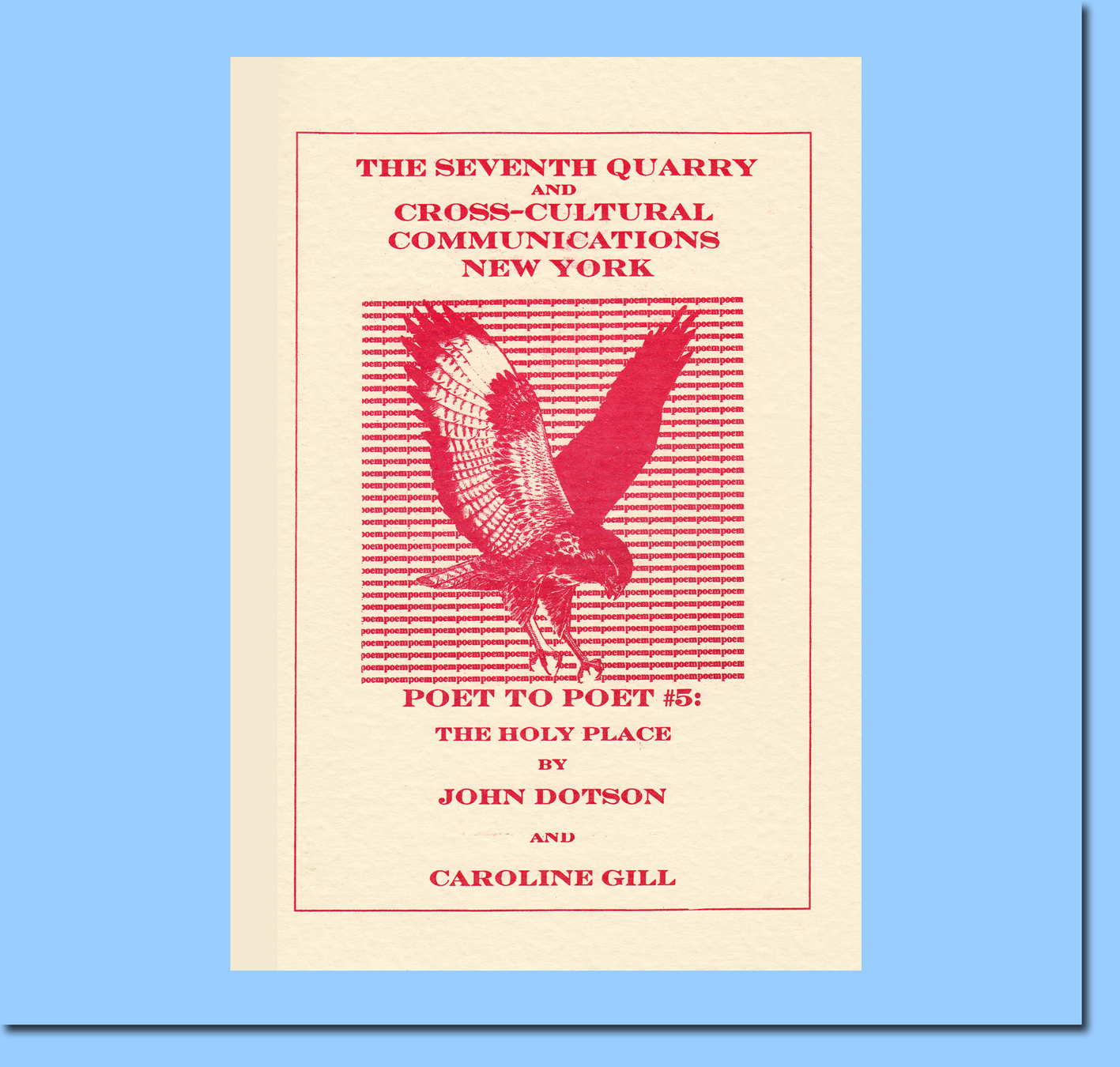
The Holy Place Chapbook: Ipwich Launch

Chapbook Launch
POETRY CAFE
IPSWICH, SUFFOLK, UK

TUESDAY 6 NOVEMBER
TIME: 7pm

All welcome (small fee)

I will be launching my chapbook, 'The Holy Place', during the evening. 
Please come and join us ... and bring a poem to read on the theme of November/Memories.

*
'The Holy Place' 

by John Dotson (USA) and Caroline Gill (UK)
is the 5th in the Poet to Poet series, 
a commissioned series published by 
The Seventh Quarry Press in Swansea (ed. Peter Thabit Jones)
 in conjunction with Cross-Cultural Communications, New York (ed. Stanley H. Barkan). 

The 3rd chapbook in this commissioned series contains poems
 by Aeronwy Thomas, (daughter of Dylan Thomas) and Maria Mazziotti Gillan (USA).


Monday, 8 October 2012

Publication Pointer: The Holy Place Chapbook

More details of this chapbook can be found here

How would you define a chapbook?

I have been asked this question a few times since my recent 2012 chapbook (above), co-authored with John Dotson, was published.

Most people are au fait with 'poetry pamphlets'; and in many or most cases today, a chapbook and a pamphlet are synonymous. Indeed, some Oxford Dictionaries say as much. What fascinates me, however, is the origin of the word, 'chapbook'. Perhaps chapbooks are more widely known these days on the western side of the Atlantic.

Here are a few facts:
  • the word has its origin in the 'chapmen' or itinerant hawkers, who by the 1600s would often peddle small stitched-together pamphlets of poems, ballads, alphabets and short prose. The Old English for such people was céapmann. Our word, 'cheap', is linked to this, and was originally indicative of a good deal. 'Chap' as in 'very good chap' came to mean a potential or actual customer. An 18th century example of the word appears here.
  • chapbooks reached the height of their appeal in the last quarter of the 18th century.
  • the historical progress of the chapbook is hard to document because few records were kept by those who sold these small works - and many chapbooks were 'of the moment' and not produced with longevity in mind.
  • Samuel Taylor Coleridge published his 1796 series entitled The Watchman in chapbook format, thereby giving the reputation of the chapbook a facelift.
  • The Rights of Man by Thomas Paine (who was born not far from here in Thetford) was published in chapbook form. Thousands of copies of this publication were produced.   
I hope to be reading from The Holy Place at the monthly Poetry Cafe in Arlington's, Ipswich, on Tuesday 6 November 2012. The Poetry Cafe is open to all (small fee to cover costs) and begins at 7pm. Do come and join us ... and bring a poem to share. 
If you would like to find out more about The Holy Place, there is a link here to my website. This commissioned chapbook has been published by Peter Thabit Jones of The Seventh Quarry Press in Swansea in conjunction with Stanley H. Barkan of Cross-Cultural Communications, New York.

The commissioned chapbook series runs as follows:

Poet to Poet #1: Bridging the Waters: Swansea to Sag Harbor
by Vince Clemente and Peter Thabit Jones (2008)

Poet to Poet #2: First and Last Things

by J.C. Evans and Annabelle Moseley (2009)

Poet to Poet #3: Nightwatch

by Aeronwy Thomas and Maria Mazziotti Gillan (2010)
 
Poet to Poet #4: Poems East Coast/West Coast
by Stanley H. Barkan and Carolyn Mary Kleefeld (2010)

Poet to Poet #5: The Holy Place
by John Dotson and Caroline Gill (2012)
 
Poet to Poet #6
by Sultan Catto and Jean Salkilld - forthcoming

Thursday, 4 October 2012

Fiesta Time: National Poetry Day Poetree Workshop

'... when the stars threw down their spears ...' 
William Blake

We gathered in Gainsborough Community Library in Ipswich for a National Poetry Day afternoon. The library had a Poetree in its foyer, and we were each invited to add a poetic leaf to the branches. Of course, we had to write the poems first!

It was soon time for a series of exercises designed to flex our poetic muscles. We played a kind of 'write a poem' version of Consequences, selecting words or phrases that could be incorporated into our own poetic offerings. So eventually, armed with ideas, words and phrases, we each selected a fine art picture ... and tried to harness our thoughts, ensuring that we had a brief but pretty well honed piece to transcribe onto our respective leaves.

Each person had been invited to bring and share a favourite poem, and we had the chance to say why our choices particularly appealed. I chose The Tyger by William Blake. It was one of the first animal poems to roar along into the poetic menagerie of my childhood. It is, I believe, a poem that can appeal to young and old alike. It celebrates the creative process, and you can almost hear the hammer banging away on the anvil as you read it aloud. Other selected poets included (among others) Eliot, Wordsworth and Yeats.


Poetree leaves, T.S. Eliot poems, pens, paper and coffee ...

... the leafy ingredients ...

... of much industry ...

We gathered by the Poetree ...

... to hang our leaves...

... on the green branches ...

... inside the green library building ...

... where a lot of fun ...

... was had by all!

This could be you!

Fiesta Time: National Poetry Day 2012

'when the stars threw down their spears ...' William Blake (artwork © C Gill)

I wonder how you will be celebrating National Poetry Day!

I am looking forward to the Gainsborough Community Library poetry workshop here in Ipswich. We shall be toning our poetry muscles and honing our poetry techniques. Each participant is due to present a favourite poem. No prizes for guessing which one I have chosen!

I hope to throw a link to NPD sites I see during the day ... so let's start with the official National Poetry Day site, which can be found here.


Friday, 28 September 2012

Writing Workshops (1): Gainsborough Community Library, Ipswich

The lamp post in Narnia? 

I joined others at Gainsborough Community Library in Ipswich yesterday for a Creative Writing Workshop. We were considering the topic of 'plot', which is not something that crosses my path very often in my poetry endeavours, although it certainly has a bearing on narrative poems. It made me realise (again) just how fundamental the concept of 'story' is to our lives.

The ancient Greeks knew this all too well, with their epic ring cycles that would allow the same yarn to be narrated in fresh ways. A child's version of Homer's Odyssey captured my own imagination at a young age. I went on to study and teach Classical Civilisation. We also think of Beowulf and of countless other myths and legends that became part of the warp and weft of our human society. The New Testament parables, stories told for a purpose, rely heavily on narrative. Think of 'The Sower' or 'The Prodigal Son'. Journalists tell stories. Most of us do.

But how often do we employ story-telling techniques in our poems? Should we be telling more stories if it is these tales that help us to come together and forge connections? We were talking yesterday about 'martyrdom' (among other things) as a feature that is common to many well-loved tales.'The Chronicles of Narnia', which we cited by way of example, speak for themselves at one level but also probe the heights and depths of something more - the Christian story, of good over evil, of the laying down of life for others.

The employment of an extended metaphor has been recognised as a popular and successful poetry ploy in recent years. Epic is 'out' in the traditional sense - or is it? There have been exciting re-workings of the old sagas and tales, but archaic language and sentiment have largely been abandoned or, at least, re-cast. I am currently reading 'Now All Roads lead to France' by Matthew Hollis, about the life and last years of Edward Thomas. It is fascinating to read about the Georgian poets and how very different they were to the emerging Imagists. Edward Thomas had a great gift for sharing small insights into the world of nature with his readers. Of course, he often employed narrative along the way: think of 'The Owl'. Today we worry whether it is 'enough' for a poem simply to paint a picture. Our response has sometimes been to use poetry as a vehicle for (often political) change. Adjectives and adverbs are treated with extreme caution - sorry, with caution - but are we sometimes in danger of aspiring to an art that is losing touch with its recipients? Poets may be driven to write for any number of reasons, but I found it helpful yesterday to be reminded that 'plot' is occasionally a useful tool to select from the work(shop) box.

P.S. And in case you were wondering, my organic writing in the workshop yesterday focused on an orphan, a multi-cololoured explosion and a rift in the cliff face ...

  • Do check out the Magma feature on Imagist poetry here

Saturday, 22 September 2012

International Echoes: Orizont Literar Contemporan


This is the latest edition of Orizont Literar Contemporan from Bucharest, Romania. As usual, it has been edited by Daniel Dragomirescu, with his wealth of experience in the field of bringing people together through the sharing of literature in its many different guises. Not for nothing does this multicultural journal have the strapline 'all the world in a magazine': this issue alone contains prose and/or literary criticism from many countries including Japan (Keiko Amano), Nigeria (Biola Olatunde) and India (Trishita Banerjee), in addition to poetry from - among other corners of the globe - Scotland (Neil Leadbeater), Wales (Byron Beynon) and Uganda (Zakaria Tiberindwa).

Do visit the website and find out more!