Showing posts with label wildlife. Show all posts
Showing posts with label wildlife. Show all posts
Monday, 9 July 2012
Anthology Alert (13): A Pocket Full of Spring Fever

Tuesday, 31 January 2012
Publication Pointer (4): Rivers of Britain by Stuart Fisher
 |
| Book Cover, used with permission |
 |
| Little Egret, Loughor Estuary |
Rivers of Britain is a beautifully produced volume, packed with glossy photographs of Britain's best known tidal, picturesque and industrial rivers. Small waterways are not forgotten. Stuart Fisher, editor of Canoeist magazine, is extremely well qualified when it comes to writing on this topic. He even undertook some of his research from the vantage point of his kayak.
Most of the 70 chapters begin with a few lines of geographically topical poetry. These chapters are illustrated with an array of fine photographs, not only of the waterways but also of topical postage stamps and book covers (John Buchan Society member that I am, I was particularly pleased to spot The Thirty-Nine Steps on the pages relating to the Firth of Tay). There are wildlife pictures like the urban fox on p.84 and the young seal on p.149. Each river is described in detail. Maps are provided along with brown sidebars of factual information, such as the length of a given watercourse, its OS location and nearest rescue services.
I was particularly pleased to find quality photographs of familiar haunts such as St Benet's Abbey, the King Harry Ferry, the nymph and dolphin mosaic from Fishbourne and the Chanonry Point Lighthouse, to name but a few. I wonder which of the featured places are favourites of yours, when it comes to 'messing about on the river' ...
- Rivers of Britain, Estuaries, Tideways, Havens, Lochs, Firths and Kyles by Stuart Fisher can be purchased from the A & C Black online shop. Click here.
Thursday, 1 September 2011
Magazine Moment (26): Dolphins in Danger

 |
| In contrast to Bottlenose Dolphins in some other places, these are free to enjoy life off the Scottish coast, 2011 |
My poem about the plight of some Bottlenose Dolphins has just been published in issue 156 of Reach Poetry (ed. Ronnie Goodyer and Dawn Bauling, Indigo Dreams Publishing Ltd).
You can find more here about dolphins in peril.
You can see more 'happy' dolphins here.
I apologise for the recent intermittent nature of my posts. We are in the (slow but busy) process of moving house ...
Monday, 18 April 2011
Magazine Moment (22): The Dawntreader
 |
| Mount Grace, Yorkshire, daffodil season |
We always enjoy a visit to Mount Grace when we are in the area. The Priory is fascinating in itself, but I am particularly drawn to the wildlife in this beautiful setting. We have just returned from another wonderful visit. I was even tempted to pull out my pocket watercolours ...
We found a frog in a Medieval water course at the back of one of the reconstructed cells. I kept a sharp eye out for wasps' nests, as I had seen one on a previous occasion. My waspish Sonnet, 'Matriarch at Mount Grace', has just been published in The Dawntreader (p.9, issue 14, Spring 2011, ed. Dawn Bauling, IDP).
 |
| Wasp nest, Mount Grace, April 2011 |
Tuesday, 25 January 2011
Prizes and Commendations (2): The T.S. Eliot prize
My thanks to Matt Merritt at Polyolbion for alerting me to the coverage of the prize ceremony on Jane Holland's blog, here. Derek Walcott won the prize with his Faber collection, White Egrets.
In case you have not caught up with the news reports, you can read The Guardian's feature here.
I recall a happy evening at Hay some years ago, when Derek Walcott answered questions and delivered his poetry to a packed auditorium. I was particularly pleased to have bought a copy of his 'Omeros' in the Poetry Bookshop that afternoon.
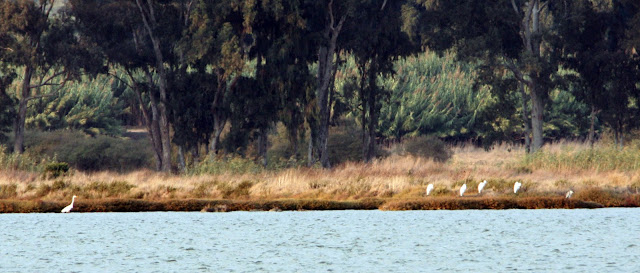
N.B. My photos are not linked to locations or symbolic representations in the book, but it seemed a good opportunity to appreciate these fine birds! The Egretta alba, the Great White Egret, has black feet and a yellow bill, unlike the Little Egret on one leg in the Divari Lagoon photo.
 |
 |
| Little Egret, Penclawdd, Gower, Wales, UK |
I recall a happy evening at Hay some years ago, when Derek Walcott answered questions and delivered his poetry to a packed auditorium. I was particularly pleased to have bought a copy of his 'Omeros' in the Poetry Bookshop that afternoon.
 |
| Above and below: Little Egret, Divari Lagoon, Pylos, Greece |

N.B. My photos are not linked to locations or symbolic representations in the book, but it seemed a good opportunity to appreciate these fine birds! The Egretta alba, the Great White Egret, has black feet and a yellow bill, unlike the Little Egret on one leg in the Divari Lagoon photo.
Tuesday, 8 June 2010
Window on Wildlife (11): Dragonflies
These creatures begin life in the water and move out from it as they develop. We have about forty types of Dragonfly and Damselfly in the UK. More than twenty species can be seen at WWT Llanelli. I am wondering how many varieties I have spotted here and at Dinefwr near Llandeilo.
I am a total novice at Dragonfly identification; any help here would be appreciated!
 Above
Above

I have not been able - as yet - to identify this Dragonfly.
It had compact heavy features
and seemed to enjoy dive-bombing, 'helicopter-style', into the water.
 Same as above
 Same as above
 Same as above
 Same as above:
I think it may be a Chaser
(having looked at a Four-Spotted Chaser on the Kenfig blog here)
I will focus on the Damselfly in my next post.
I am a total novice at Dragonfly identification; any help here would be appreciated!
 Above
Above? Aeshna juncea - Common Hawker
P.S. July 2010: For an update on this I.D. [i], please see comments below![ii]


I have not been able - as yet - to identify this Dragonfly.
It had compact heavy features
and seemed to enjoy dive-bombing, 'helicopter-style', into the water.
 Same as above
 Same as above
 Same as above
 Same as above:
I think it may be a Chaser
(having looked at a Four-Spotted Chaser on the Kenfig blog here)
[vi]


N.B. I have attempted to give each individual Dragonfly a number e.g. [vi],
which will appear just above a its photograph.
It is possible that there may be more than one example of any species.
which will appear just above a its photograph.
It is possible that there may be more than one example of any species.
I will focus on the Damselfly in my next post.
Thursday, 27 May 2010
Creature Feature (16): Wildlife at Mwnt, Gwbert and Cardigan Island
 Mwnt from the Cardigan Farm Park
 You can just make out the white bell tower of the Church of the Holy Cross, halfway up on the right.
We enjoyed a visit to Mwnt on the Cardigan coast of Wales last weekend.
The weather was glorious and we saw some interesting wildlife.
This was the first sign (below) we saw as we left the NT car-park at Mwnt...

This is the church in its glorious setting...

We were just enjoying our cliff-top picnic when we spotted our first seal...

After lunch we drove the short distance on to Gwbert,
to do the coastal walk around the Cardigan Island Coastal Farm Park.
We were thrilled to see this Common Lizard,
who had ventured indoors.
It was 'rehabilitated' seconds after this photo was taken.

Out on the cliffs we spotted a few Oystercatchers...


having watched Pipits earlier at Mwnt...

Suddenly we spotted this 'tortoiseshell' bird.
It was my first Turnstone:
an exciting moment!
The bird is sporting its breeding plumage.

By now, we could see Cardigan Island very clearly
from our gorse-lined cliff path...

I tried out my mini-tripod for the first time,
to see if I could get a steady shot of the bluebells on the island,
and of the nesting gulls.
I'm afraid I was only moderately successful,
but it gives an idea of the beautiful blue swathes.

We spent ages with these gulls, waiting for more seals to surface,
but the tide was high
and there were a lot of motor boats about, making quite a racket,
despite the speed limit in these conservation waters.
but the tide was high
and there were a lot of motor boats about, making quite a racket,
despite the speed limit in these conservation waters.

The Herring Gull below was nesting on the rock between the mainland and the island.

I have often seen Burnet Moths on the cliffs at Mwnt.
We were too early this time, but I did spot the caterpillar below.
It unrolled itself and trundled off into the grass.
It was pretty fat!
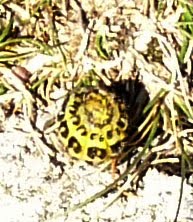
There were scores of small blue butterflies from the Lycaenidae family,
but they were too fast for me to catch on film
and I did not like to disturb them.
However, this beautiful creature from the same family
was quite unperturbed
as I took its photograph
on the way back to the car...
 Small Copper Butterfly
Postscript...
We kept our eyes on the water as much as we could in the hope that the Porpoises or Bottlenose Dolphins would appear. We did not spot any on this occasion, but I was pleased to read on the Whales in Wales blog that they were definitely around. I hope you were able to enjoy fine weather in your neck of the woods, and that you spotted some interesting flora and fauna, too.
- BBC website: Gwbert panorama
- A Coastcard Land&Lit post on the Mwnt | Bardsey Island literary associations
Saturday, 6 March 2010
Window on Wales (3): Beach Huts, Langland

It's been a long winter, but at last there are signs of spring. My thoughts even turned on to summer when I read Kay's post about beach huts. It made me wonder whether those of you who live in other parts of the UK or beyond have a beach hut photo to post?
I took these in the summer, when there were blue skies overhead. Langland is on the Gower Peninsula. It is adjacent to Mumbles and very close to Swansea, home town of the poet, Dylan Thomas.
I took these in the summer, when there were blue skies overhead. Langland is on the Gower Peninsula. It is adjacent to Mumbles and very close to Swansea, home town of the poet, Dylan Thomas.

Incidentally, speaking of Gower, you might enjoy looking at these fabulous adder photographs at Nicholaston on the Welsh Wildlife site, accessed via the excellent Gower Wildlife Blog. I was amazed to think of adders in early spring, especially after such a cold winter.
Wednesday, 27 January 2010
Beautiful Birds (18): RSPB Big Garden Bird Watch - and Blog Carnivals

A little reminder about the annual RSPB Big Garden Birdwatch this weekend - on 30 and 31 January 2010. Do consider taking part. You can find the details here. There may even be an organised activity in your neck of the woods.


On the subject of birds and their habitats, there is probably still time for you to take part in two of the forthcoming international nature-orientated Blog Carnivals, 'I and the Bird' (IATB site here, deadline 4 February) and the 'Festival of the Trees' (deadline for blog-post submissions: 30 January).
Don't miss the present IATB carnival, hosted on and around a lake created by Seabrooke Leckie ('The Marvelous in Nature' blog) in rural eastern Ontario. This is well worth a visit for the ingenious artwork in addition to the wonderful linked blogs.
You can read my FOTT post here on my Land&Lit blog for a blend of wildlife and history. If you see trees with an artist's eye, you might well enjoy a virtual wander through the new Cornish exhibition, Of Woods and Trees, at Beside the Wave Gallery in Falmouth, UK.
Don't forget: Tuesday 2 February is World Wetlands Day! It marks the date of the adoption of the Convention on Wetlands on 2 February 1971, in the city of Ramsar in Iran, on the shores of the Caspian Sea. Each year since 1997, participants have tried to find ways of raising public awareness of wetland values and benefits.
Don't miss the present IATB carnival, hosted on and around a lake created by Seabrooke Leckie ('The Marvelous in Nature' blog) in rural eastern Ontario. This is well worth a visit for the ingenious artwork in addition to the wonderful linked blogs.
You can read my FOTT post here on my Land&Lit blog for a blend of wildlife and history. If you see trees with an artist's eye, you might well enjoy a virtual wander through the new Cornish exhibition, Of Woods and Trees, at Beside the Wave Gallery in Falmouth, UK.
Don't forget: Tuesday 2 February is World Wetlands Day! It marks the date of the adoption of the Convention on Wetlands on 2 February 1971, in the city of Ramsar in Iran, on the shores of the Caspian Sea. Each year since 1997, participants have tried to find ways of raising public awareness of wetland values and benefits.
Thursday, 14 January 2010
Beautiful Birds (17): Round Redwing*
 White Wigwam?
Redwings may be quite common at this time of year, but it was a FIRST for us because we have not seen them in the garden before. When I blogged about the species a year ago (almost to the day), I posted a Redwing photograph, taken in the Mumbles area of Swansea by Mary Roberts - here. I love the distinctive white stripe on the head.
Matt Merritt of Polyolbion left the following informative comment on my post:
'They're pretty much Song Thrush sized.Very few breed in the UK, but large numbers arrive, along with Fieldfares (which are more like Mistle Thrush sized), from Scandinavia every winter. They're very fond of berry trees and windfall apples.'
I wonder what avian or 4-legged unexpected visitors have turned up in your garden...
Incidentally, while I am on the subject of wildlife, do take a look at Seabrooke's AMAZING résumé of her 2009 posts on The Marvelous in Nature from the wilds of eastern Ontario. Her photography is wonderful and her natural world stars are often extraordinary!
On the subject of snow, do remember to visit the new Polar Poets blog, hosted by Susan Richardson (from South Wales) and Siobhan Logan. Today's post is about Siobhan's fascination with and studies of the Northern Lights.
*And finally, talking of Round Robins (quite a controversial blog topic in the run up to Christmas), my thanks go to the 'Snow Watch' team for explaining in basic scientific terms the reason why it is beneficial for a bird to fluff up its feathers in the cold, making itself look more rotund than normal...
Monday, 21 December 2009
Creature Feature (11): A River Seal?

 Photos: we watched these seals in Scotland in July, during a summer holiday.
They knew where they would find fish scraps from the local fishermen!
It is not unusual to see the occasional seal around our Gower coast (designated Area of Outstanding Natural Beauty), but I don't think I have ever encountered a seal in a local river before.
- The seal with its trout in the River Neath (BBC blog)
- Pinnipeds
Tuesday, 10 November 2009
Creature Feature (11): Wales News - Dolphins use Jellyfish in ocean football
 We watched these dolphins (in the photos above and immediately below) in the Moray Firth,
near Fort George, Scotland, in September 2009

We spotted these Bottlenose Dolphins (in the photo below) off Pembrokeshire, Wales

Those who read my blog regularly will know that I enjoy keeping up with Professor P. Brain's ecological and environmental discoveries. This story about Bottlenose Dolphins particularly caught my eye.
Wednesday, 19 August 2009
Meme Moment (1): Transformative Moment


Puffins at Bempton Cliffs
(RSPB), Yorkshire, UK
Today is the big day! I have found it extremely hard to pick on one defining moment for the purposes of this post (see Steven's blog). The traveller in me would pick the day I flew to Amsterdam and visited Anne Frank's House. The poet in me would pick the day when I won poetry competition at the age of eleven for a poem entitled 'Koala Bear'. The animal lover in me would go for the afternoon when I came home with my first dog. The athlete in me (joke, joke) would select the occasion when I received a small green rosette for coming third in the flowerpot race. What about my many Cornish moments which have shaped my thinking ever since? What about that expedition to Corinth on a school trip, when I stood at the outdoor bema (preaching desk), supposedly used by the Apostle Paul?
Those of you who have followed this blog, however, will not be surprised to find that I have chosen to recall the day when I saw my first puffins in the wild. This last statement is not strictly true, for we had been on the look-out a year earlier, and we think we saw one solitary puffin through a kind birder's highly magnified lens.
We returned to the spot the following year, and this time there was no Yorkshire fret hugging the coast, so the visibility was much better. To our great delight, we saw puffins - through binoculars and with the naked eye. They were nesting. Some had stalks of grass in their beaks and others were finding a cliff ledge hole in which to rear a family. Others were looking quizzically at the gannets. Others still were floating like little amber jewels in a necklace on the sea.
WHY am I so drawn to puffins, I wonder? Yes, they are definitely cute. Yes, they need all the 'friends' they can muster in these days when numbers are declining in sites like the Farne Islands. Yes, they are photogenic and pose a challenge for the photographer. Yes to all these thoughts. However, it is something more that compels me to watch puffins. These small birds have taught me not only to spend time outdoors, enjoying the wonders of creation but they have made me want to understand something of what I see and sense around me. I find myself wondering where the puffins came from and where they will go (and I never was one for geography!).
Puffins have made me appreciate other birds, too. You cannot go to Bempton Cliffs in the spring without being blown away by the gannet colony, not to mention the Razorbills and Guillemots. However, it is not only the spectacular birds which catch my attention these days, although I admit to being a sucker for bright colours! I believe I saw my first Corn Bunting last week in Wiltshire, and I definitely saw my first Osprey in Scotland earlier in the summer.
My blogging activities have put me in touch with some wonderful birders. I am still very much a beginner when it comes to identifying the different species; but my knowledge and my appetite for bird knowledge have both increased enormously since that 'Eureka!' puffin moment. It is not only birds. When I am out with binoculars, I find myself on the look-out for butterflies, insects, caterpillars, lizards, newts, wild flowers, fungi, mice, deer, trees and so many interesting examples of flora and fauna.
The poet, Edward Thomas, has long been a favourite of mine. He served in the Great War, and died when he was hit by a stray shell. Thomas was a keen observer of all that he saw. He wrote prose initially (who could resist his description of the watercress man?). Later he turned his hand to poetry and found new ways of using words. He was a great friend of the poet, Robert Frost - and as I close this post, I am reminded of Frost's immortal lines about the parting of the ways in the wood. I am so grateful to that first puffin for leading me down a new path of discovery, and to all the poets and bloggers who are helping me to learn more about the beautiful but fragile world around me.
Two favourite poems to sum up the essence of my thoughts:
- The Road not Taken by Robert Frost (1915)
- Words by Edward Thomas (1915)
Here goes in alphabetical order... Enjoy!
- Christian Nature (reflections, photos, poetry...)
- Crafty Green Poet (Haiku, poetry, craft, green living)... and ReadWritePoem Nature Poetry Group
- East Anglian Skies (Wendy Webb and guests... don't miss the Sitooterie!)
- Ecobirder (wonderful photography)
- Faith, Fabric and Photos (I love the photos!)
- From the Field Book (avian poetry with Carol Thistlethwaite)
- GreenyGrey's Rambles (link to lovely swan on YouTube)
- Maureen Almond's Blog (this link is about trees)
- Nature Blog Network (join the gang!)
- Photo Hebrides (peace, beauty and photographs)
- Poefusion (poetry, wildlife and all sorts from Michelle)
- Polyolbion (birds and poetry with Matt Merritt)
- Professor David Morley (Cowper's hares and all sorts)
- Professor P. Brain's Blog (local to me)
- Raph's Ramblings (don't miss this one: 'wild life' with a difference!)
- Rock Paper Lizard (amazing moth eggs)
- Susan Richardson's Blog (poetry, the Arctic and other wild places)
- The Altered Page (new ways of seeing...)
- The Marvelous in Nature (Seabrooke's amazing wildlife blog: observations, phtography and art)
- The Weaver of Grass (threads of the countryside, literature, poetry, art and so much more)
- Vickie Henderson Art (truly amazing cranes!)
- Wildlife and Nature Photography (sheer beauty)
- Wildlife on Wheels ('wildlife stories and photos from a wheelchair' - wonderful)
Subscribe to:
Posts (Atom)