Tuesday, 30 April 2019

When is a Book not a Book?

Marble memorial

This post may be just a little off-topic, but I have just learned a new word...

B L O O K.

There is even a book about blooks and you can buy it here

According to its author, Mindell Dubansky, blooks are 'books that aren't', and the reason for this is that they are frequently, but by no means exculsively, made of stone like the ones in the memorial above, which adorn the church of St John the Evangelist in Oxborough, Norfolk. 

My interest in blooks stems from a piece about a small marble book I co-authored in 2010 with my husband, David Gill. It was published in OUP's Notes & Queries, volume 57. Little did I realise at that point that a stone book was, or would come to be known as, a blook. 

Earlier this evening I came across an article entitled Carved in Stone: American Stone Books by Ian Berke in the Maine Antique Digest (2015). The author had also written a guest post on Mindell Dubansky's blog, About Books - discovering the book as object.  

For more information ...

Was this delicious 'book cake' a 'blook'?

Saturday, 22 December 2018

Winter Update, 2018


This picture seemed to me to have a wintry feel despite the fact the photograph was taken in summer! It depicts the Skye Bridge and the small island of Eilean Bàn. I have posted it to accompany a link (here) to my Skye poem, The Ceilidh House, about winter in the Inner Hebrides in times gone by. My thanks to Sharmagne and her editorial assistants for publishing my poem in the December issue of Quill and Parchment.

Special thanks, too, to Matthew Stewart for including this blog in his Rogue Strands 2018 list of poetry blogs. I feel very honoured to receive another mention. Thank you, Matthew.

A summary of my 2018 poetry activities can be found here

Wednesday, 7 November 2018

'Remembrance 100' and 'With Remembrance in MIND'


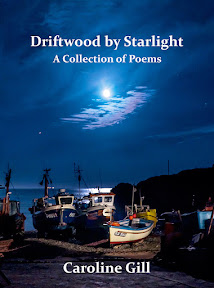
I have been running and judging a poetry competition in and for my local community as part of the programme of 'Remembrance 100' events in our church to mark the centenary of Armistice Day. The image above forms part of the cover of our competition pamphlet of poems. I have added a blue border to this screen image as, not surprisingly, white failed to show up on white!

The winners have been announced, and I am greatly looking forward to our Prize-giving Reading later this month.  

I shall be at a different church tomorrow evening, reading my Christmas Truce poem from Towards the light (Kapaju Books, 2018) ...


Monday, 5 November 2018

Poetry in Aldeburgh, 2018


I can hardly believe how quickly Poetry in Aldeburgh has come and gone this year. The weather was largely bright and fresh, and I'm guessing more poets braced the icy waters of the North Sea than on previous years, though I only actually saw one swimmer emerging over the shingle bank as I savoured my chips. 


I attended two workshops. They were both excellent, but very different from one another. My Friday workshop was led by Helena Nelson of HappenStance Press, and concerned the 'Ps' of having poetry published. My Saturday one, led by Pascale Petit, encouraged us to venture out of our comfort zones into the world of 'wild' and 'dangerous' writing.


So what did I buy during the weekend? Well, I was fairly restrained this year, having made a number of poetry purchases recently; but two volumes I could not resist were Mama Amazonica by Pascale Petit (having attended her 'wild' workshop) and a secondhand copy of The Trumpet and Other Poems by Edward Thomas. I added Kathleen Jamie's Collected Poems to my wishlist, perhaps with Christmas in mind, though I doubt I will feel I want to wait that long...


There is always a buzz in Aldeburgh during the days of the Festival, and it is always good to meet up with friends and to make new ones. The task now is to return to my notebook and attempt to tidy up those workshop drafts...

Wednesday, 31 October 2018

Poetry 'with Remembrance in MIND'


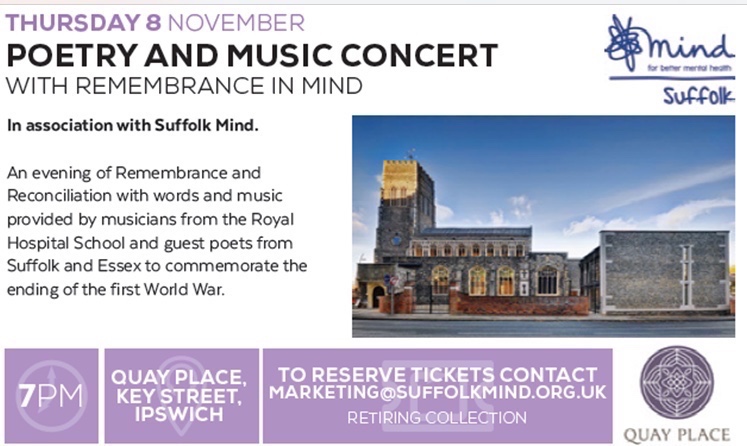
I shall be reading my (acrostic) First World War poem from Towards the light (Kapaju Press, 2018) at this Remembrance concert in aid of the charity, Suffolk MIND. Details of the evening are on the flyer above. Do come and support this worthy cause.


Monday, 22 October 2018

Judging a Remembrance Poetry Competition

My task for today (well, for this week, but I must make an immediate start) is to judge a local poetry competition linked to the centenary of the end of the First World War.

I knew from a fairly early age that the relatives of close family friends and indeed members of my own family had served in the conflict, but somehow the days around Remembrance Sunday were strange ones for my teenage self. They were evidently days that made people I knew well 'feel' something that I sensed was still beyond my grasp and strangely beyond my reach.

I studied the Peloponnesian and Persian wars at university in a detached historical way. I took courses on Homeric warfare in which we tried to link archaeological artefacts with passages in the text, thereby building up a rounded picture of the ancient world from the range of primary sources available. I loved the challenges presented by this approach, but war itself remained an enigma. Perhaps war is always an enigma.

Some years later I had the chance to study work by the war poets; and seeing, well, almost experiencing, conflict and service through their eyes lifted a veil from my own. The poems that spoke most directly to me about the aspiration for peace (something I felt deeply) and the reality of 20th century hostilities (something I almost wished to avoid) were those that tackled the subject from a slightly oblique angle. 'The Owl' by Edward Thomas would be a case in point.

I have returned to that poem many times. In four brief quatrains, the speaker presents a world of war that is vividly evoked but barely described. As I have mentioned above, I live with aspirations of peace, but at a moment when I was finally receptive to the exploration of modern notions of conflict (with the aim of increasing my understanding), it only took a handful of well-chosen words to extend my appreciation of human loyalty and sacrifice in the face of battle. The poet's employment of a double entendre, or play, on the word 'barred' is, to my way of thinking, a stroke of genius - and ironically it was one of the words in this poem that became a personal key, unlocking empathy and gratitude for those caught up directly or indirectly in the atrocities of the First World War.

Wednesday, 17 October 2018

Christmas Anthology


It may be a bit soon to be mentioning the 'C' word while we are still in October, but members of the Association of Christian Writers have just brought out this anthology of stories, poems and reflections about the true meaning of Christmas. I am delighted to have a poem in the volume.